12.1 Purpose and Scope
OSP infrastructure is a long-lived asset. Its value depends on sustained performance over decades, not merely on successful initial construction. Effective maintenance, rapid restoration capability, and deliberate lifecycle management protect the owner’s investment and ensure service continuity for campus, carrier, utility, and government networks.
This chapter addresses inspection programs, preventive and corrective maintenance, emergency restoration, spare-capacity strategy, and asset-management practices. Guidance is aligned with the BICSI Outside Plant Design Reference Manual (OSPDRM) 6th Edition (which includes a dedicated chapter on maintenance and restoration), the BICSI G-series standards, FOA practices, and current industry experience as of 2026.
12.2 Maintenance Philosophy
Professional OSP maintenance is proactive rather than purely reactive. The goals are to:
- Detect and correct degradation before it causes service failure
- Preserve pathway capacity and accessibility
- Maintain accurate records for future work
- Minimize the duration and impact of unavoidable outages
- Extend the useful life of the plant
A documented maintenance program, with assigned responsibilities and adequate budget, is essential.
12.3 Inspection and Preventive Maintenance
Regular inspections should cover:
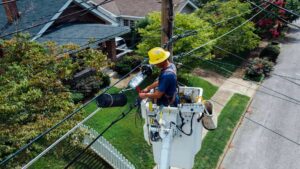
- Aerial plant — poles, anchors, guys, clearances, lashing integrity, vegetation encroachment, and storm damage
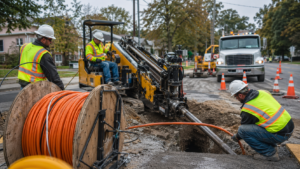
- Underground plant — manhole/handhole condition, drainage, cable racking, corrosion, and evidence of unauthorized access or damage
- Direct-buried routes — surface settlement, marker condition, and evidence of excavation activity
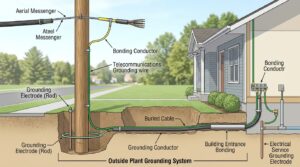
- Building entrances — bonding continuity, protector condition, firestopping, and cable transitions
- Bonding and grounding systems — continuity and corrosion
Inspection frequency is risk-based: more frequent for critical routes, joint-use poles, high-traffic corridors, and areas with known environmental stress. Findings are recorded, prioritized, and tracked to closure.
Vegetation management, especially on aerial routes, is a continuous requirement. Pole integrity testing and replacement programs are standard for aging aerial plant.
12.4 Emergency Restoration
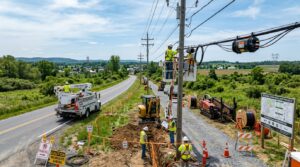
Despite best efforts, cable cuts, pole failures, and storm damage occur. Effective restoration depends on:
- Accurate as-built and GIS records that allow rapid location of the fault
- Pre-positioned spare cable, closures, and hardware
- Trained restoration crews and established call-out procedures
- Pre-negotiated access rights and traffic-control arrangements
- Clear prioritization of circuits (especially for utility SCADA, public safety, and critical government services)
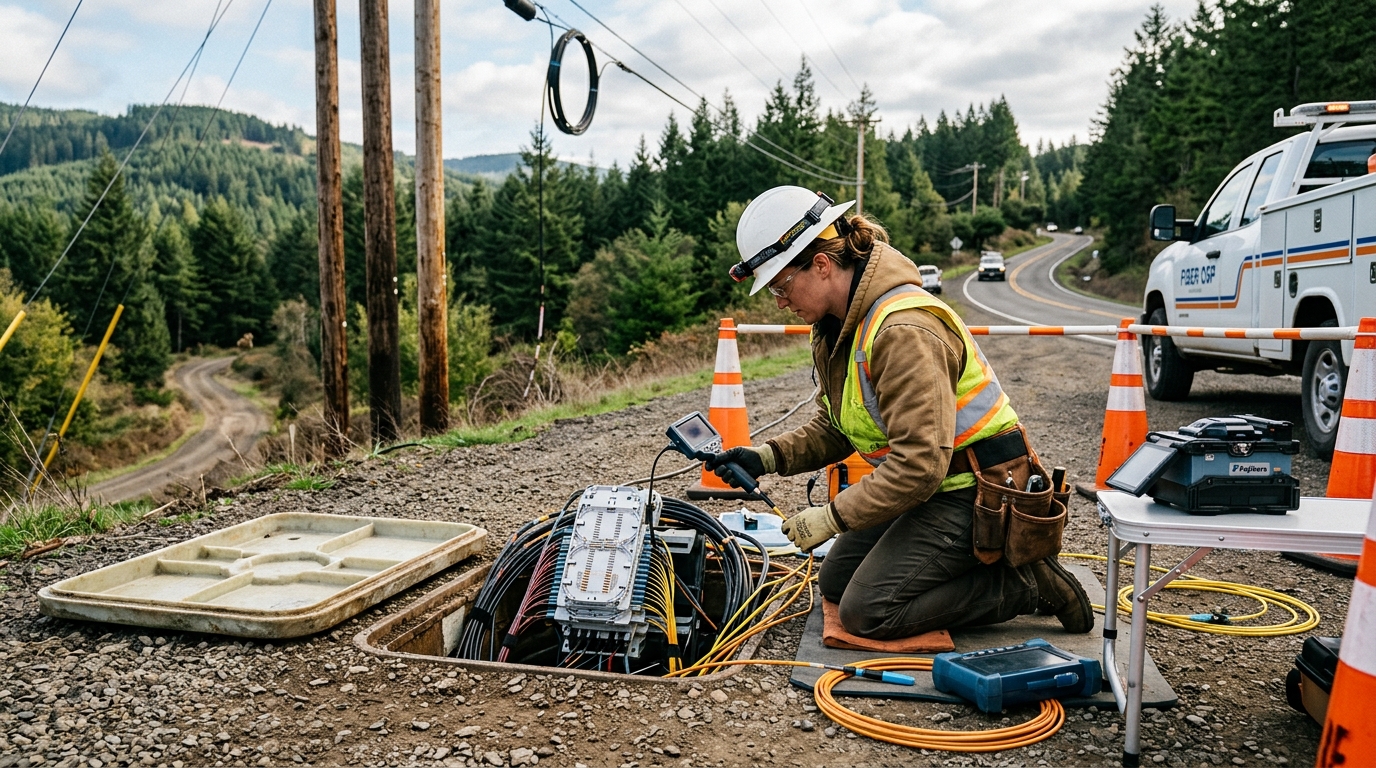
Optical time-domain reflectometer (OTDR) testing from both directions, combined with good records, is the primary method for locating fiber faults. Temporary restoration (e.g., aerial jumper or temporary duct) may be used to restore service quickly, followed by permanent repair.
Post-event reviews identify root causes and opportunities to improve resilience (additional pathway diversity, improved marking, stronger poles, etc.).
12.5 Spare Capacity and Pathway Management
Spare ducts, innerducts, and fiber counts are finite resources. Lifecycle management includes:
- Tracking remaining capacity on every route segment
- Reserving capacity for known future needs
- Avoiding unnecessary consumption of spares for low-priority or temporary requirements
- Planning parallel or diverse routes before existing pathways reach exhaustion
Owners that treat spare capacity as a managed asset avoid the high cost and disruption of emergency pathway construction.
12.6 Asset Management and Records
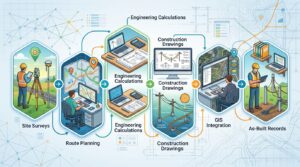
Modern OSP asset management relies on accurate, accessible records—preferably in GIS or a dedicated outside-plant management system. Essential data include:
- Cable routes, types, counts, and lengths
- Splice and termination locations
- Pathway details (duct counts, manhole identities, pole numbers)
- Test results and maintenance history
- Right-of-way and permit information
Records must be updated after every change. Incomplete or outdated records dramatically increase restoration time and cost.
12.7 Lifecycle Planning
OSP plant should be evaluated periodically for:
- Remaining useful life of cables and structures
- Technology obsolescence (e.g., legacy copper or low-count fiber)
- Changing capacity or reliability requirements
- Opportunities for consolidation or upgrade during other civil works
Planned replacement or augmentation is almost always preferable to reactive replacement after failure.
12.8 Application Notes by Network Type
Campus — Emphasis on aesthetic maintenance, coordination with grounds and facilities staff, and protection of pathways during campus construction projects. Carrier — Highly structured inspection and restoration programs; strong focus on mean-time-to-repair metrics and diverse routing. Utility — Integration with overall utility maintenance systems; high priority on SCADA and operational circuits. Government — Formal inspection schedules, security considerations for access to manholes and cabinets, and continuity-of-operations planning.
12.9 Summary
Maintenance, restoration, and lifecycle management convert a constructed OSP asset into a reliable, long-term service platform. A disciplined inspection program, prepared restoration capability, active management of spare capacity, and accurate records are the hallmarks of professional practice. When these elements are in place, the infrastructure continues to meet the demanding requirements of campus, carrier, utility, and government networks throughout its service life.
FAQ
What Is OSP Maintenance?
OSP maintenance is the systematic inspection, monitoring, repair, and upkeep of outside plant infrastructure to preserve network reliability, capacity, accessibility, and service life.
What Does OSP Preventive Maintenance Include?
OSP preventive maintenance can include inspection of aerial and underground plant, vegetation management, pole and structural inspections, manhole and handhole inspections, bonding and grounding checks, pathway inspections, and review of cable and splice conditions.
How Are Fiber Optic Cable Faults Located?
OTDR testing is commonly used to identify the approximate location of fiber faults. Testing from both directions, combined with accurate cable and splice records, can improve fault-location accuracy and accelerate restoration.
Why Is OSP Asset Management Important?
Accurate OSP asset records allow operators to identify cable routes, splice locations, pathway capacity, structures, test results, and maintenance history. Reliable records reduce troubleshooting and restoration time.
Why Is Spare OSP Capacity Important?
Spare ducts, innerducts, and fiber capacity provide flexibility for future network expansion and emergency restoration. Managing this capacity as an asset helps avoid costly and disruptive pathway construction.