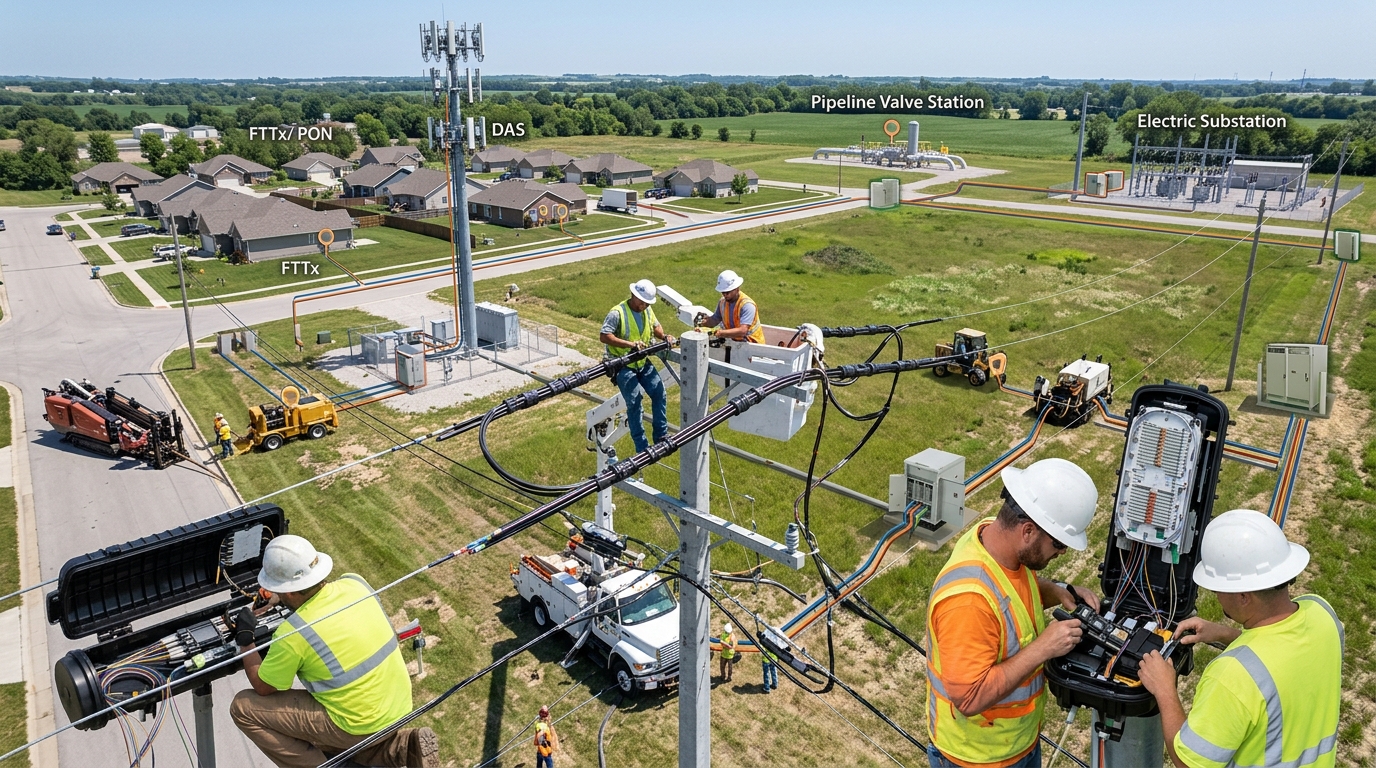
13.1 Purpose and Scope
While the fundamental principles of OSP design and construction apply broadly, certain applications impose unique technical, operational, or regulatory requirements. This chapter addresses specialized OSP applications frequently encountered by RCDDs, OSP Designers, ICT consultants, and telecommunications engineers working on campus, carrier, utility, and government networks.
Guidance is aligned with the BICSI Outside Plant Design Reference Manual (OSPDRM) 6th Edition (which includes dedicated material on PON, RFoG, and related technologies), current TIA and FOA practices, and industry experience as of 2026.
13.2 Passive Optical Networks (PON) and FTTx
Passive Optical Networks are widely deployed for fiber-to-the-home (FTTH), fiber-to-the-premises (FTTP), and campus distribution. Key OSP considerations include:
- Centralized vs. distributed splitter architectures and their impact on fiber counts and splice locations
- Outdoor plant protection of splitters (cabinets, pedestals, or underground enclosures)
- Higher fiber counts and denser splicing in distribution segments
- Strict cleanliness and loss-budget discipline because of the passive split
- Drop cable designs (often hardened connectors or pre-terminated) for final drops
- Future-proofing for wavelength growth and higher split ratios
OSPDRM 6th Edition contains specific guidance on OSP aspects of PON design and installation. Proper pathway capacity and slack storage are essential because later adds are common.
13.3 Radio Frequency over Glass (RFoG)
RFoG is used primarily by cable operators to overlay traditional RF services on a fiber infrastructure. OSP requirements include:
- Compatibility of optical transmitters, receivers, and nodes with the existing HFC architecture
- Careful management of optical return path and noise
- Hybrid fiber-coax transitions and the continued presence of coaxial plant in some segments
- Powering of optical nodes (often still required)
RFoG deployments must coordinate optical budget, wavelength plans, and existing coaxial infrastructure. OSPDRM addresses RFoG-specific OSP considerations.
13.4 Distributed Antenna System (DAS) and Small-Cell Backhaul
Wireless densification drives significant OSP demand for DAS and small-cell backhaul. Typical requirements include:
- High fiber counts to support multiple carriers and MIMO configurations
- Diverse routing for reliability
- Power delivery (AC, DC, or hybrid fiber-power cables) to remote radio units
- Compact, aesthetically acceptable enclosures and pathways on campuses and in urban environments
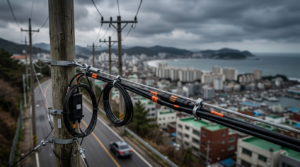
- Strict adherence to attachment and make-ready rules on utility poles
All-dielectric designs are often preferred near power facilities. Coordination with wireless carriers and power utilities is intensive.
13.5 Utility SCADA and Operational Networks
Electric, gas, water, and other utilities rely on OSP for supervisory control and data acquisition (SCADA), distribution automation, and internal communications. Distinguishing features include:
- Extremely high reliability and low-latency requirements
- Frequent joint-use with power infrastructure, triggering heightened NESC clearance, bonding, and induction-mitigation rules
- Preference for all-dielectric cable near high-voltage lines
- Segregation or prioritization of operational traffic from enterprise traffic
- Integration with utility-owned fiber or leased capacity
Ground-potential rise and fault-induction analysis are often required near substations.
13.6 High-Reliability and Government / Military Networks
Government, defense, and critical-infrastructure networks frequently demand:
- Pathway diversity (physically separate routes)
- Protected Distribution Systems (PDS) or equivalent physical security measures for sensitive circuits
- Enhanced monitoring and rapid restoration capability
- Compliance with agency-specific specifications (e.g., Unified Facilities Guide Specifications)
- TEMPEST or other emanation-security considerations in some environments
- Strict access control to manholes, cabinets, and splice points
Redundancy is designed into both the pathway and the media layers. Documentation and configuration control are typically more rigorous than in commercial projects.
13.7 Hybrid and Multi-Media Networks
Many networks combine optical fiber with limited copper or coaxial segments. Designers must manage:
- Transition points and media conversion
- Different maintenance and testing regimes
- Bonding and surge-protection requirements that apply only to the metallic portions
- Long-term strategy for eventual copper retirement
Hybrid designs are common during migration phases or where specific end devices still require copper.
13.8 Design and Construction Implications
Special applications often drive:
- Higher fiber counts and denser closures
- More stringent loss budgets and testing protocols
- Additional pathway diversity or physical security
- Specialized enclosures, power systems, or monitoring
- Closer coordination with non-telecommunications stakeholders (wireless carriers, utility operations, security officials)
The core OSP principles—proper pathway selection, media choice, bonding, documentation, and quality installation—remain the foundation. Special applications simply add layers of performance, security, or operational constraint.
13.9 Summary
PON/FTTx, RFoG, DAS backhaul, utility SCADA, high-reliability government networks, and hybrid systems each impose distinct requirements on OSP design and construction. The professional designer recognizes these differences early, incorporates them into route selection, capacity planning, and specifications, and applies the fundamental practices established in earlier chapters. When properly addressed, these specialized networks achieve the reliability, security, and performance demanded by their operators.