9.1 Purpose and Scope
No OSP design can be constructed without legal authority to occupy the land or structures along the route. Right-of-way (ROW), easements, permits, and joint-use agreements form the legal foundation of every outside plant project. Failures in this area produce the most common and costly delays, change orders, and legal disputes in OSP work.
This chapter addresses the identification, acquisition, and management of rights-of-way and the associated permitting and stakeholder coordination processes. Guidance is drawn from the BICSI Outside Plant Design Reference Manual (OSPDRM) 6th Edition, the BICSI G-series standards, NESC requirements, FCC pole-attachment rules, and current industry practice for campus, carrier, utility, and government networks as of 2026.
9.2 Types of Right-of-Way and Access Rights
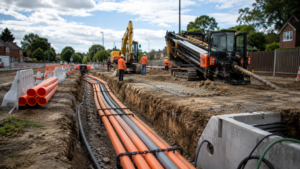
Public Right-of-Way Public streets, highways, and associated corridors are controlled by municipal, county, or state agencies. Access is normally obtained through permits or franchises rather than ownership. Conditions typically include restoration standards, traffic control, insurance, and time limits.
Private Property Crossing or occupying private land requires an easement, license, or fee-simple acquisition. Easements should be perpetual, assignable, and recorded. Early title research and negotiation are essential.
Utility Corridors and Joint-Use Attachment to existing poles or occupancy of existing ducts is governed by joint-use or attachment agreements with the pole or conduit owner (usually the electric utility). These agreements define make-ready responsibilities, rates, and technical standards.
Railroad, Waterway, and Special Corridors Crossings of railroads, navigable waterways, or controlled-access highways require specialized permits from the railroad company, U.S. Army Corps of Engineers, state DOT, or other authorities. Lead times are often long.
Federal and Tribal Lands Projects on federal property or tribal lands involve additional processes (e.g., special-use permits, NEPA reviews, or tribal consultation).
9.3 The Permitting Process
Successful permitting begins with early identification of every authority having jurisdiction (AHJ). A typical project may require permits from:
- Local public works or engineering departments (street-cut / ROW permits)
- State departments of transportation
- Environmental agencies (wetlands, storm-water, endangered species)
- Railroads
- Utilities (joint-use / make-ready)
- Building departments (for cabinets, vaults, or building entrances)
- Federal agencies when federal funding or federal land is involved
Best practice is to hold pre-application meetings with key AHJs to clarify requirements, timelines, and submittal expectations. Incomplete or inaccurate applications are a primary cause of delay.
Recent federal policy discussions (including 2026 FCC and related initiatives) continue to emphasize reducing barriers and establishing reasonable timelines for wireline deployments in public rights-of-way, although local control remains significant.
9.4 Joint-Use and Make-Ready
On aerial routes the make-ready process is frequently the critical path. FCC rules (47 CFR Part 1) establish timelines and procedures for pole attachments in many jurisdictions. The sequence generally includes:
- Application and completeness review
- Survey / engineering analysis
- Make-ready estimate and authorization
- Performance of make-ready work (pole replacement, rearrangement, guying, etc.)
- Attachment and inspection
The OSP Designer must identify pole ownership, existing attachments, available space, and loading capacity early. Costs and schedule impacts of make-ready work must be incorporated into the project plan. NESC clearance and strength requirements govern the technical feasibility of attachments.
9.5 Utility Coordination and One-Call Requirements
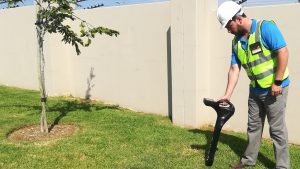
Excavation without proper notification is illegal and dangerous. Designers and constructors must comply with state one-call (811) laws. In addition to the legal notification requirement, proactive coordination with all existing utility owners—through joint meetings, subsurface utility engineering (SUE), and shared mapping—reduces conflict and damage risk.
9.6 Environmental and Cultural Resource Considerations
Many routes trigger environmental review. Wetland permits, storm-water pollution prevention plans, cultural-resource surveys, and endangered-species clearances can add months to the schedule. Campus and government projects often face heightened scrutiny for aesthetic and historic impacts. Early screening and engagement with environmental specialists are essential.
9.7 Stakeholder Coordination by Network Type
Campus — Coordination is primarily internal (facilities, landscape, security, IT) plus local municipal permits for any public ROW crossings. Aesthetic and restoration requirements are often stringent.
Carrier — Extensive external coordination with multiple municipalities, DOTs, railroads, and pole owners across long routes. Franchise agreements and pole-attachment contracts are central.
Utility — Frequent joint-use with power facilities; internal utility standards and inter-utility agreements dominate. Ground-potential-rise and induction issues may influence route selection.
Government — Multi-agency review is common. Security, continuity-of-operations, and specialized specifications (e.g., UFGS) add layers of approval. Federal or military installations introduce unique access and security protocols.
9.8 Documentation and Risk Management
All rights, permits, and agreements must be documented and tracked. Design drawings should clearly show ROW limits, permit boundaries, and known utility conflicts. A permit matrix listing every required approval, responsible party, submittal date, and status is a standard project-control tool. Contingency time and budget for permitting and make-ready should be included in every realistic schedule and estimate.
9.9 Summary
Right-of-way acquisition, permitting, and stakeholder coordination are not administrative afterthoughts; they are core engineering and project-management functions. The OSP Designer must identify every required right and approval at the earliest stages, engage stakeholders proactively, and integrate legal and regulatory constraints into route selection, design, cost, and schedule. Success in this area determines whether a technically sound design can actually be built.
FAQ
What is ROW in outside plant design?
ROW, or right-of-way, is the legal authorization to occupy or access property needed to construct and maintain outside plant telecommunications facilities.
What permits are required for fiber optic construction?
Fiber projects may require municipal ROW permits, state DOT permits, environmental approvals, railroad crossing permits, utility approvals, building permits, and other authorizations depending on the route.
What is make-ready work?
Make-ready work is the modification of existing utility infrastructure required before a new telecommunications attachment can be installed, including pole replacement, rearrangement of existing attachments, guying, and other necessary work.
Why is utility coordination important in OSP design?
Utility coordination identifies existing infrastructure and reduces construction conflicts, utility damage, schedule delays, unexpected costs, and safety risks.
What is a pole attachment agreement?
A pole attachment agreement establishes the terms under which a telecommunications provider may attach facilities to utility poles or other infrastructure owned by another party.
Why is 811 notification required?
811 notification helps identify underground utilities before excavation so construction crews can avoid damaging existing infrastructure and comply with applicable one-call requirements.
What is an OSP permit matrix?
A permit matrix is a project-control document that tracks required approvals, responsible parties, submission dates, status, lead times, and other permitting information.
What stakeholders are involved in OSP construction?
Stakeholders can include municipalities, DOTs, utilities, pole owners, property owners, railroads, environmental agencies, building authorities, campus departments, government agencies, and telecommunications operators.