14.1 Purpose and Scope
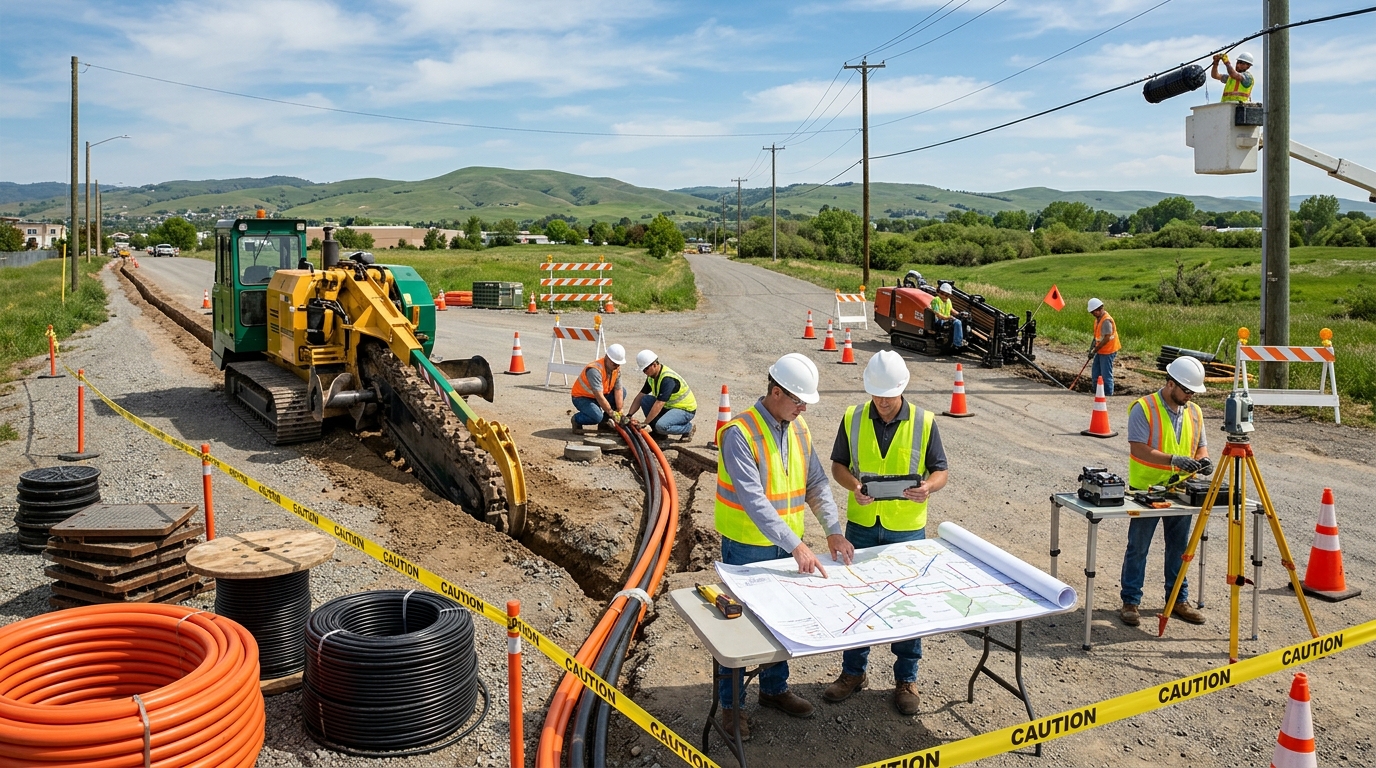
OSP projects are inherently multidisciplinary and often span multiple jurisdictions, owners, and technical domains. Technical excellence alone is insufficient; successful delivery requires disciplined project management and proactive risk mitigation. This chapter addresses the project-management practices and risk-management approaches expected of RCDDs, OSP Designers, ICT consultants, and telecommunications engineers responsible for complex campus, carrier, utility, and government OSP projects.
Guidance reflects principles consistent with the BICSI Outside Plant Design Reference Manual (OSPDRM) 6th Edition, BICSI project-management resources, and current professional practice as of 2026.
14.2 Project Management Framework
Effective OSP project management integrates:
- Clear scope definition and requirements baseline
- Realistic scheduling that accounts for permitting, make-ready, and weather
- Cost estimating and budget control
- Procurement and material logistics
- Quality assurance and inspection
- Stakeholder communication and change control
- Safety and environmental compliance
- Close-out and knowledge transfer
The OSP Designer frequently serves as a technical lead or subject-matter expert within a larger project team and must understand how design decisions affect cost, schedule, and risk.
14.3 Cost Estimating
Accurate estimating requires breakdown of:
- Pathway construction (trenching, boring, pole work, manholes)
- Cable and hardware
- Splicing, termination, and testing
- Make-ready and joint-use costs
- Permitting, restoration, and traffic control
- Engineering, inspection, and contingency
Historical data, unit-price libraries, and vendor quotations improve accuracy. Contingency should reflect project complexity, right-of-way uncertainty, and subsurface risk. Underestimating permitting or make-ready costs is a common source of overruns.
14.4 Scheduling
Critical-path items on OSP projects typically include:
- Right-of-way and permit acquisition
- Utility coordination and make-ready
- Long-lead materials
- Seasonal or environmental work windows
- Dependent civil or building works
Schedules must incorporate realistic durations for AHJ reviews and external dependencies. Parallel activities (e.g., detailed design while permits are in process) are used where risk is acceptable. Regular schedule updates and look-ahead planning keep the project aligned.
14.5 Change Management
Changes are inevitable. A formal change-control process should:
- Document the proposed change and its technical basis
- Assess impacts on cost, schedule, performance, and risk
- Obtain required approvals before implementation
- Update drawings, specifications, and records
Uncontrolled field changes are a primary source of as-built inaccuracy and future maintenance problems. The Designer must evaluate whether a proposed change maintains compliance with codes, standards, and the original design intent.
14.6 Risk Identification and Mitigation
Major risk categories on OSP projects include:
- Right-of-way and permitting delays
- Unknown subsurface conditions and utility conflicts
- Joint-use / make-ready disputes or delays
- Material shortages or long lead times
- Weather and environmental restrictions
- Safety incidents
- Incomplete or inaccurate existing records
- Stakeholder opposition or late requirements changes
Risk registers, early utility coordination, subsurface utility engineering (SUE), pre-application meetings with AHJs, and contractual risk allocation are standard mitigation tools. Pathway diversity and spare capacity also serve as long-term operational risk mitigations.
14.7 Liability and Professional Responsibility
The OSP Designer carries professional responsibility for the technical adequacy of the design within the defined scope of services. Key practices that manage liability include:
- Clear definition of scope and exclusions
- Documentation of assumptions and owner-furnished information
- Adherence to applicable codes, standards, and the standard of care
- Structured quality-control review of deliverables
- Timely communication of risks and recommendations to the client
- Proper retention of project records
Errors-and-omissions insurance is standard for firms providing OSP design services. Field decisions that deviate from the approved design should be evaluated and documented.
14.8 Communication and Stakeholder Management
Complex OSP projects involve numerous internal and external parties. A communication plan that identifies stakeholders, information needs, and reporting frequency reduces misunderstandings. Regular coordination meetings, clear RFI processes, and transparent reporting of issues build trust and accelerate resolution.
14.9 Close-Out and Knowledge Transfer
Project close-out includes:
- Final as-built documentation and GIS updates
- Test results and acceptance records
- Spare materials and residual cable
- Transfer of permits, warranties, and maintenance recommendations
- Lessons-learned review
Complete close-out protects the owner’s ability to operate and expand the plant and reduces the Designer’s residual exposure.
14.10 Application Notes by Network Type
Campus — Heavy coordination with facilities, landscape, and concurrent construction projects; aesthetic and restoration expectations are high. Carrier — Large geographic scale, multiple jurisdictions, and strong emphasis on unit-cost control and rapid restoration metrics. Utility — Integration with existing utility project-controls systems and strict outage and safety protocols. Government — Formal stage-gate reviews, security requirements, and compliance with agency acquisition rules.
14.11 Summary
Complex OSP projects succeed when technical design is paired with disciplined project management and proactive risk mitigation. Cost estimating, realistic scheduling, formal change control, systematic risk management, and clear communication are essential professional competencies. When these practices are applied consistently, the resulting infrastructure meets performance requirements while remaining within budget and schedule constraints.
FAQ SEO
What is OSP project management?
OSP project management is the coordinated planning, design, construction, quality control, risk management, and closeout of outside plant telecommunications infrastructure.
What are the biggest risks in OSP projects?
Common risks include permitting and right-of-way delays, unknown subsurface conditions, utility conflicts, make-ready requirements, material shortages, weather restrictions, safety incidents, inaccurate existing records, and changing stakeholder requirements.
Why is cost estimating important in OSP projects?
Accurate estimating helps control budgets by accounting for construction, cable and hardware, splicing, testing, permitting, restoration, traffic control, engineering, make-ready, and appropriate contingency.
What is change management in OSP design?
OSP change management is the formal process for documenting proposed changes, evaluating their technical, cost, schedule, performance, and risk impacts, obtaining approvals, and updating project records.
What is make-ready risk in OSP projects?
Make-ready risk arises when existing utility infrastructure must be modified to accommodate new telecommunications facilities. Delays, disputes, costs, and coordination requirements can significantly affect OSP schedules.
Why are accurate as-built drawings important?
Accurate as-built documentation provides the owner with reliable records for operation, maintenance, future expansion, troubleshooting, and asset management.