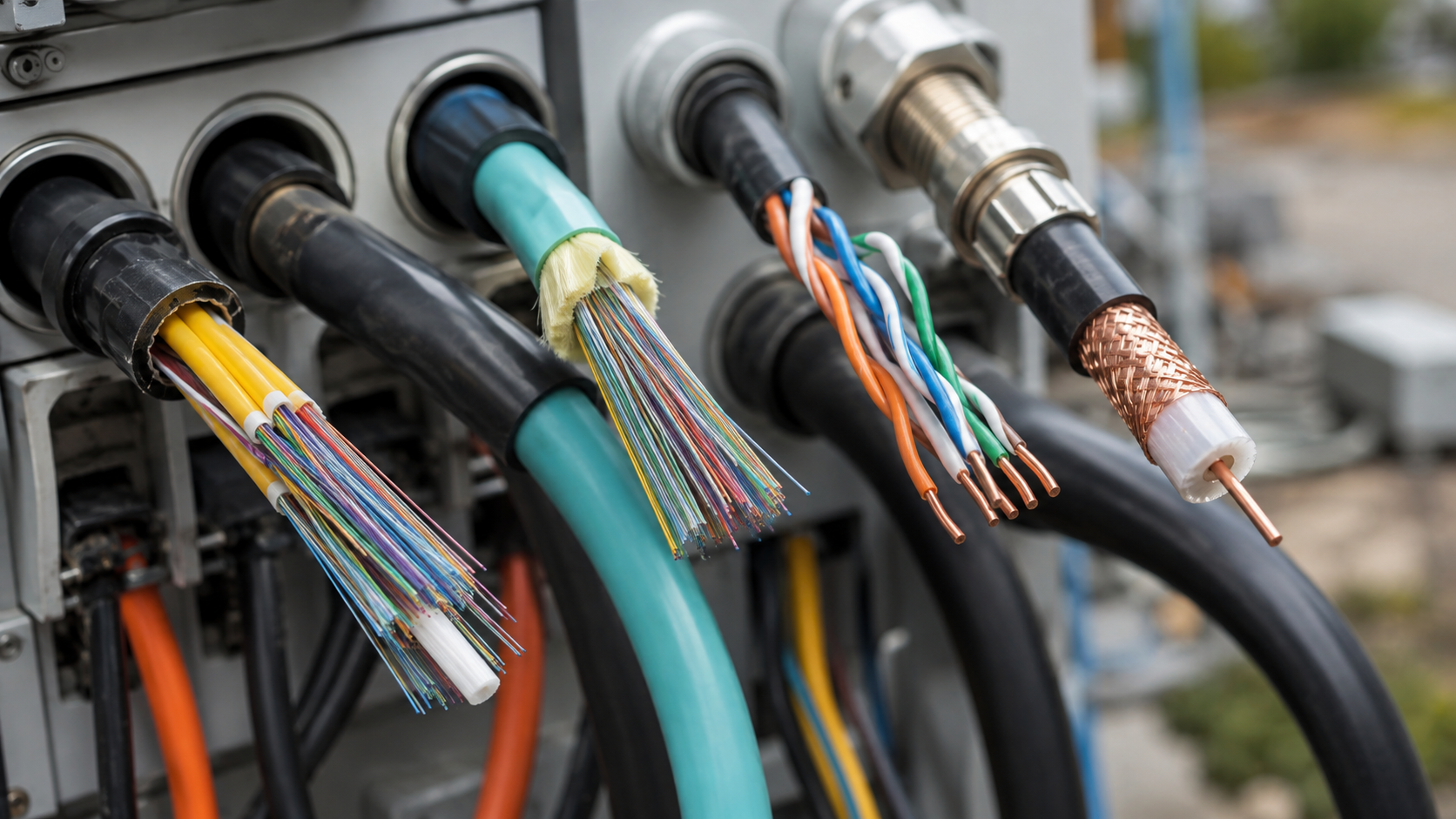
7.1 Purpose and Scope
Selection of the appropriate cabling medium is one of the most consequential decisions in OSP design. The medium must support the required applications over the planned distances, withstand the environmental and mechanical stresses of the chosen pathway, remain compatible with future technology upgrades, and satisfy applicable codes and standards.
This chapter provides guidance on the selection and performance characteristics of optical fiber, balanced twisted-pair, and coaxial media for outside plant applications. It is aligned with the BICSI Outside Plant Design Reference Manual (OSPDRM) 6th Edition, ANSI/ICEA S-87-640-2023, ANSI/TIA-568.3-E, ANSI/TIA-758-B, and related industry practices current as of 2026.
7.2 Optical Fiber – The Dominant OSP Medium
Optical fiber is the preferred medium for virtually all new campus, carrier, utility, and government OSP backbone and distribution routes because of its high bandwidth, low attenuation, immunity to electromagnetic interference, and long reach.
Single-Mode Fiber Single-mode fiber (typically G.652.D / OS2) is the standard choice for OSP. Attenuation is commonly specified at ≤ 0.40 dB/km at 1310 nm and ≤ 0.30 dB/km at 1550 nm for outdoor cable. Bend-insensitive variants (G.657) are frequently specified where tight bends or dense closures are expected. Single-mode supports all current and foreseeable high-speed applications (including DWDM and coherent systems) over campus and metro distances.
Multimode Fiber For new installations, only laser-optimized multimode fibers are recognized:
- OM3 and OM4 (aqua jacket) for short-reach applications.
- OM5 (lime-green jacket) for wideband multimode applications supporting short-wavelength division multiplexing (SWDM).
OM1 and OM2 are no longer recognized for new installations per current BICSI and TIA guidance. Multimode remains useful for short campus links or specific equipment interfaces but is rarely the primary OSP backbone medium.
Cable Constructions for OSP Outdoor optical fiber cables are manufactured to ANSI/ICEA S-87-640-2023 and are available in multiple constructions:
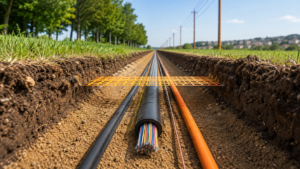
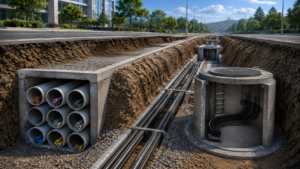
- Loose-tube (gel-filled or dry-block) – most common for duct and direct-buried applications.
- Ribbon – high fiber counts in compact packages; well suited for high-density splicing.
- Central-tube and micro-cable designs for air-blown or high-density duct applications.
- Armored (corrugated steel tape or interlocking armor) for direct burial or high mechanical risk.
- All-dielectric self-supporting (ADSS) and figure-8 for aerial use.
- Indoor/outdoor and transition cables for building entrances.
Jacket materials are typically polyethylene (PE) or medium-density polyethylene (MDPE) for outdoor durability and UV resistance. Water-blocking (gel or dry) is standard.
7.3 Balanced Twisted-Pair Copper
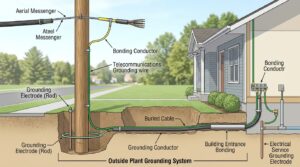
Copper remains relevant for certain short OSP runs, utility SCADA, legacy services, and hybrid applications. Outdoor-rated Category 5e, 6, and 6A cables with gel filling, dual jackets, and sunlight/UV resistance are available. Performance is limited by distance (generally ≤ 100 m for standard Ethernet applications) and by susceptibility to electromagnetic interference and ground-potential differences. When copper is used in OSP, careful attention to bonding, grounding, and surge protection is mandatory.
7.4 Coaxial Cable
Coaxial media continue to serve broadband, CATV, and certain RFoG (radio frequency over glass) or hybrid fiber-coax applications. Outdoor-rated coaxial cables with flooded jackets and appropriate shielding are specified according to the application and operator standards.
7.5 Selection Criteria
Media selection is driven by:
- Application bandwidth and reach requirements.
- Pathway type (aerial, underground, direct-buried) and associated mechanical/environmental stresses.
- Future upgrade path (wavelength growth, higher bit rates).
- Cost of cable, termination, splicing, and active electronics.
- Compatibility with existing plant and equipment.
- Regulatory and owner standards (including any preference for all-dielectric designs near power facilities).
In most modern designs, single-mode optical fiber is the default choice for OSP backbone and distribution. Multimode, copper, or coaxial are selected only when specific application or economic factors justify them.
7.6 Performance and Application Distances
Optical fiber distances are limited primarily by the optical power budget and dispersion characteristics of the selected transceivers rather than by the fiber itself. Campus and most metro links are routinely supported on single-mode fiber with comfortable margin. Manufacturer data sheets and link-budget calculations must be performed for each design.
Copper distances remain constrained by the TIA-568 channel model (typically 100 m for horizontal applications) and by PoE voltage drop when power is delivered over the cable.
Fiber vs Copper vs Coax for OSP
| Medium | Primary OSP Role | Key Advantage | Main Limitation |
|---|---|---|---|
| Single-mode fiber | Backbone, distribution, campus, carrier, utility | Long reach and very high bandwidth | Requires optical equipment and specialized termination |
| Multimode fiber | Short-reach campus/equipment links | Cost-effective for short distances | Shorter reach than single-mode |
| Category-rated copper | Short utility, legacy and specialized services | Familiar termination and power delivery | Distance, EMI and grounding limitations |
| Coaxial cable | CATV, broadband and RF applications | Excellent RF performance | Limited upgrade flexibility compared with fiber |
7.7 Special Considerations for OSP Environments
- Temperature range, moisture, UV exposure, and mechanical loading dictate cable construction.
- Rodent protection (armor or chemical deterrents) is frequently required for direct-buried routes.
- Dielectric designs are preferred near high-voltage power lines to eliminate induction and bonding issues.
- Cable markings, length markings, and fiber identification (color coding per TIA-598) must be maintained for future identification and restoration.
- Transition from outdoor-rated to indoor-rated cable at building entrances must comply with NEC length limitations and fire-rating requirements.
7.8 Documentation
Design documents must clearly specify fiber type (e.g., G.652.D or OM4), cable construction, fiber count, jacket type, armor (if any), and any special requirements (ADSS, dry-block, etc.). As-built records should include actual cable lengths, splice locations, and measured performance data.
7.9 Summary
Optical fiber—primarily single-mode—has become the standard medium for professional OSP design in campus, carrier, utility, and government networks. Proper selection of fiber type, cable construction, and performance parameters, guided by the OSPDRM 6th Edition, ICEA S-87-640-2023, and current TIA standards, ensures that the installed plant will support both present applications and future growth. Copper and coaxial media retain specialized roles but are secondary in most new OSP projects.
FAQ
What is the best cable for an OSP backbone?
Single-mode optical fiber is generally the preferred choice for new OSP backbone and distribution infrastructure because of its long reach, high bandwidth, low attenuation and resistance to electromagnetic interference.
What type of fiber is normally used outdoors?
OS2 single-mode fiber, commonly based on ITU-T G.652.D specifications, is widely used for outdoor telecommunications infrastructure. G.657 bend-insensitive fiber may be selected for applications requiring tighter bend performance.
What is the difference between OSP fiber and indoor fiber?
OSP fiber cables are designed to withstand outdoor conditions such as moisture, temperature changes, UV exposure and mechanical stresses. Indoor cables must instead meet building fire and flame requirements.
Is copper suitable for outside plant networks?
Copper can be suitable for short-distance or specialized OSP applications, but distance, electromagnetic interference, grounding, surge protection and environmental exposure must be carefully considered.
Why is single-mode fiber preferred over multimode for OSP?
Single-mode fiber provides substantially greater reach and a stronger path toward future high-bandwidth technologies, making it better suited to backbone and distribution infrastructure.
What factors determine OSP cable selection?
Key factors include bandwidth, transmission distance, pathway type, environmental conditions, mechanical protection, future capacity requirements, installation cost, equipment compatibility and applicable standards.