Key Takeaways
- Three dominant OSP methods — High Air Speed Blowing (HASB), Horizontal Directional Drilling (HDD), and microtrenching — each serve distinct terrain, budget, and density scenarios in modern fiber-to-the-x (FTTx) builds.
- HASB installations depend on precise pneumatics: 100–150 PSI of air pressure, 150–350 CFM of flow, and a three-stage duct verification process (mandrel test, pressure test, crash test) before any cable is fed.
- HDD pull-back tension is a calculated limit, not a guess — engineers size the safe pulling force from HDPE pipe wall stress and cross-sectional area, then apply a 2.0–2.5x safety factor enforced by a breakaway swivel.
- Microtrenching trades depth for speed, cutting narrow 8–18 inch trenches for dense urban last-mile builds, with backfill chemistry chosen specifically to flex with road expansion.
- Method selection is fundamentally a risk-and-context decision: open terrain favors HDD, dense urban corridors favor microtrenching, and existing duct networks favor HASB — often all three appear on the same regional buildout.
Why Installation Methodology Is Under Fresh Scrutiny
Fiber-to-the-x rollouts are accelerating across both urban infill and rural last-mile projects, and the installation method a crew picks now carries real financial and regulatory weight. Permitting authorities increasingly ask for method-specific documentation — pull-back calculations for HDD crossings, backfill specs for microtrenching — before signing off on right-of-way work. Getting the methodology wrong doesn’t just risk a failed pull or a crushed duct; it risks a stalled permit or a costly rework. That’s pushed OSP (outside plant) engineering teams to formalize the parameters below rather than treat them as tribal knowledge.
High Air Speed Blowing (HASB): Precision Pneumatics Over Raw Force
HASB, sometimes called jetting or air-assisted blowing, floats fiber cable through innerduct using high-velocity air paired with a mechanical pusher. It’s the workhorse method for feeding cable through conduit that’s already in the ground — new subdivisions with pre-installed duct banks, or upgrades to existing OSP networks.
Equipment parameters. Compressors used in HASB installs need to sustain 100 to 150 PSI (7 to 10 bar) of continuous pressure, with volumetric flow in the 150 to 350 CFM (4.2 to 10 m³/min) range depending on the duct’s inner diameter. Undersized compressors are one of the most common causes of stalled or incomplete blows on longer runs.
A three-stage verification sequence precedes any live installation:
- Proof-mandrel testing. A pneumatic mandrel sized to 80–85% of the conduit’s internal diameter is blown through the run first. If it doesn’t pass cleanly, the duct likely has a kink, crush point, or offset joint that needs remediation before cable ever enters it.
- Pressure testing. The sealed conduit is brought to working pressure — typically the same 100–150 PSI range — and held for five minutes. A pressure drop under 10% is the pass threshold; anything more suggests a leak or breach in the duct wall.
- Cable crash-testing. Before full deployment, crews feed a short cable segment into a sealed test section against a hard stop and run the pusher until the cable buckles. That failure point defines the maximum safe pushing force, and the blowing machine’s safety clutch is then set to trip at 80% of that value — a built-in margin that prevents cable damage mid-run on the real installation.
Horizontal Directional Drilling (HDD): Engineering the Pull-Back Math
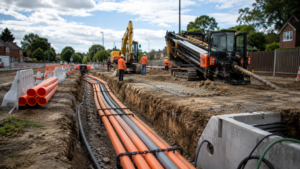
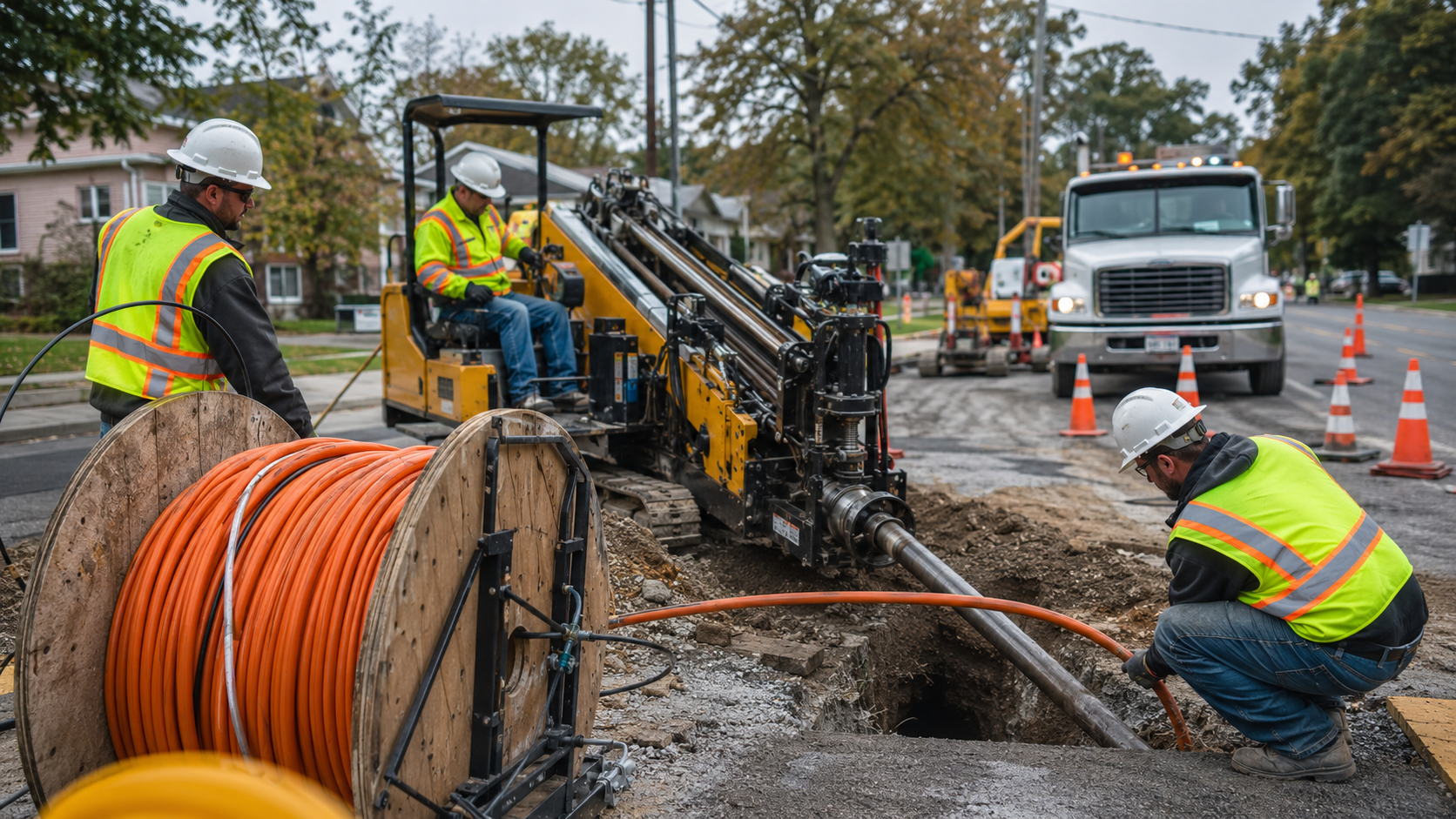
HDD is the go-to trenchless method for crossings that can’t tolerate surface disruption — active roadways, rail lines, waterways, or protected land. Rather than digging a path, HDD bores a pilot hole underground and reams it to size before pulling the conduit through.
The critical calculation here is pull-back tension. Crews need to know the maximum load the HDPE conduit can tolerate before it stretches or fails:
Safe pull-back tension:
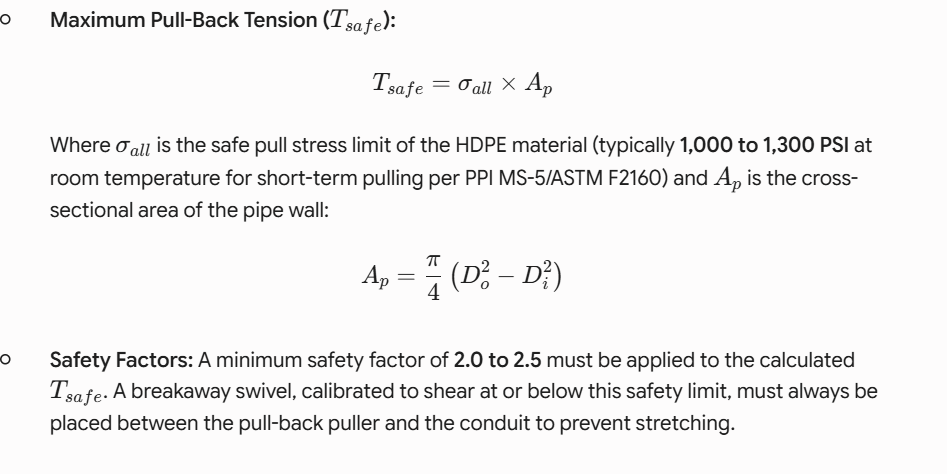
Safety margin. Engineers don’t pull anywhere near the calculated ceiling. A safety factor of 2.0 to 2.5 is applied against T_safe, and a breakaway swivel — calibrated to shear at or below that reduced limit — sits between the puller and the conduit. If tension spikes past the safe threshold (from an unexpected obstruction or bore-path friction), the swivel fails first, protecting the conduit from being overstretched or damaged.
Microtrenching: Density-Optimized, Speed-Optimized
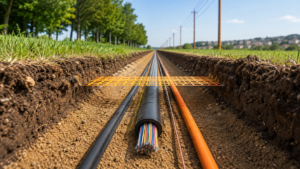
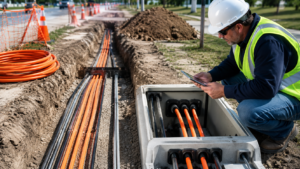
Microtrenching has become the preferred method for dense last-mile FTTx builds where speed and minimal surface disruption matter more than raw duct capacity. Instead of a traditional open-cut trench, a saw cuts a narrow channel directly into pavement or sidewalk.
Dimensions. Cuts typically run 8 to 18 inches (200–450 mm) deep and just 0.5 to 2.0 inches (12–50 mm) wide — narrow enough to avoid major traffic disruption or full-lane closures.
Duct layout. Because the trench profile is so narrow, microducts are stacked vertically rather than laid side by side, maximizing duct count within a tight footprint.
Backfill standards. Before backfilling, the trench is cleared of dust and debris with a dry vacuum — any residual grit compromises the seal. Backfill material is typically a rapid-setting elastomeric polymer concrete, flowable thermal fill, or a cold- or hot-applied asphalt sealant. The elastomeric quality matters as much as the seal itself: as roadways expand and contract with temperature, a rigid backfill would eventually shear the microducts inside it, while a flexible fill moves with the pavement and protects the ducts long-term.
FAQ
What’s the difference between HASB and traditional cable pulling? HASB uses high-velocity air combined with a mechanical pusher to float the cable through the duct with minimal friction, which reduces stress on the cable jacket compared to a straight mechanical pull, especially over long or curved runs.
Why does HDD require a breakaway swivel instead of just monitoring tension manually? Pull-back tension can spike suddenly if the drill string hits unexpected soil resistance or an obstruction, faster than an operator can react. A breakaway swivel calibrated below the safety threshold fails automatically, protecting the conduit before it’s overstressed.
Is microtrenching suitable for every road surface? Not universally — suitability depends on pavement composition, existing utility congestion below the surface, and local right-of-way rules, which is why utility locating and backfill material selection are treated as separate engineering steps rather than an afterthought.
How is the correct HDD pipe size determined for a given pull? Engineers calculate the pipe wall’s cross-sectional area from its outer and inner diameters, then work backward from the desired safety factor and the HDPE material’s allowable pull stress to confirm the conduit can handle the anticipated pull-back tension for that specific bore length and soil condition.
Closing Analysis
None of these three methods is displacing the others — the trend is toward more rigorous, standardized qualification of each one rather than consolidation around a single approach. What’s still unsettled is how consistently these parameters (mandrel sizing, pull-back safety factors, backfill specification) get enforced across smaller regional contractors versus large fiber operators, since documentation requirements vary by permitting authority. Expect continued pressure from municipalities for pre-installation testing records, particularly for HDD crossings under critical infrastructure, as fiber buildouts intersect more often with congested underground utility corridors.