What Is Vacuum Excavation?
Vacuum excavation—also known as soft digging, potholing, or hydro/air excavation—is a non-destructive technique used to safely and precisely expose underground utilities. It is the primary method for achieving ASCE/UESI/CI 38-22 Quality Level A (QL-A) data in Subsurface Utility Engineering (SUE) and has become a standard risk-reduction tool on professional outside plant (OSP) telecommunications projects.
In OSP work, vacuum excavation is commonly used to verify the exact location, depth, size, and condition of existing utilities before trenching, directional boring, duct-bank installation, or placing new pathways. When properly applied, it significantly reduces the risk of damaging fiber optic cables, conduits, and other critical infrastructure.
Basic Principle
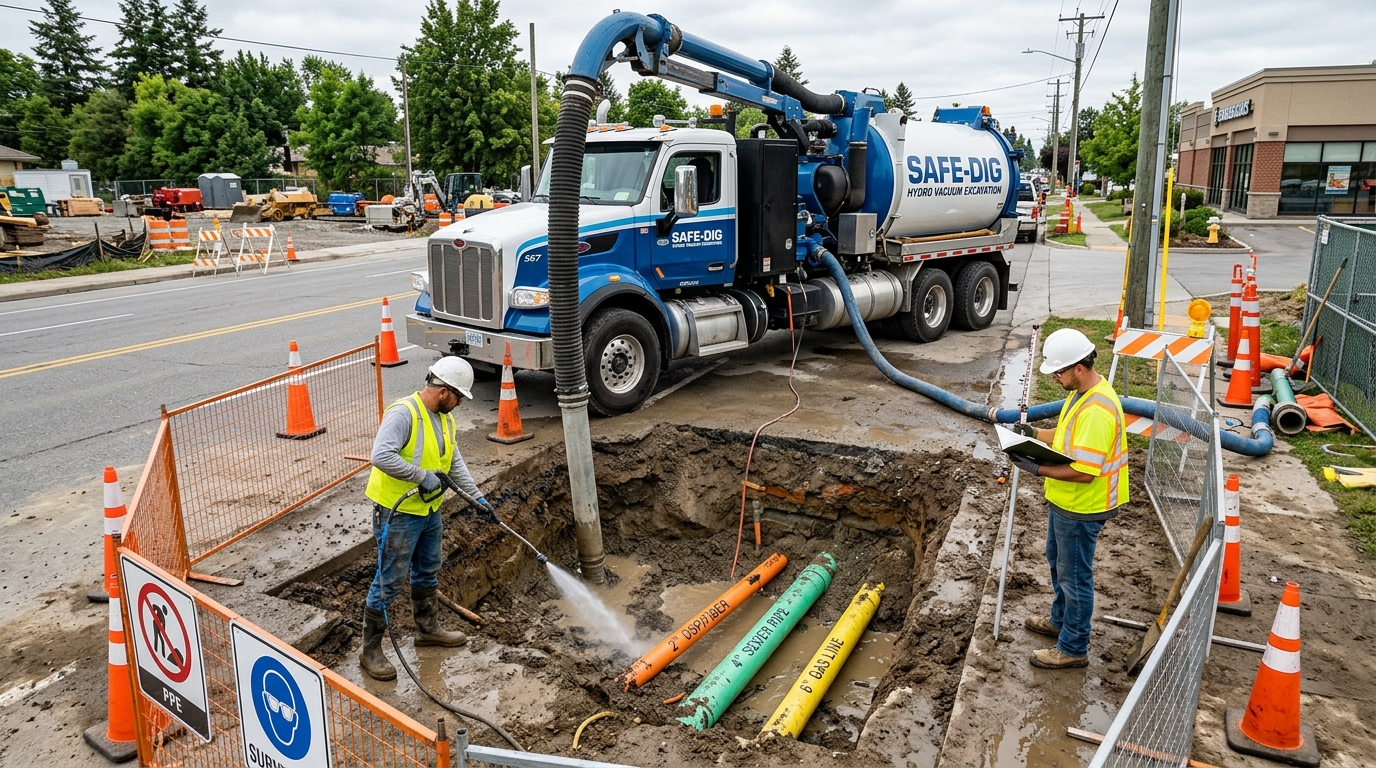
Vacuum excavation combines a high-volume vacuum system with a cutting medium (pressurized water or compressed air) to break up and remove soil. Unlike traditional mechanical excavation, it applies minimal force to the buried utilities themselves. This controlled approach allows crews to expose facilities cleanly while greatly lowering the chance of strikes or damage.
Main Types of Vacuum Excavation
1. Hydro-Excavation (Water Vacuum Excavation) Pressurized water (typically 1,000–3,000+ psi) is injected through a wand to fluidize the soil. A powerful vacuum simultaneously removes the resulting slurry into a debris tank.
Hydro-excavation is the most widely used method because water performs well across a broad range of soil types, including clay, silt, sand, and moderate rock. Its main drawbacks are the need to manage and dispose of slurry and reduced effectiveness in freezing temperatures.
2. Air (Pneumatic) Excavation Compressed air is used to loosen the soil, which is then vacuumed into the tank as dry spoil.
Air excavation is preferred when water is undesirable—near sensitive electrical facilities, in freezing climates, or where slurry disposal is difficult or expensive. It is generally slower than hydro-excavation in heavy clay or compacted soils but offers cleaner spoil handling and lower risk around energized plant.
Many modern vacuum units are dual-mode and can switch between air and water as soil conditions change.
Typical Equipment
A standard vacuum excavation setup includes:
- Truck- or trailer-mounted vacuum system with a large debris tank
- High-pressure water pump or air compressor
- Digging wand or lance
- Vacuum hose (commonly 6–8 inches in diameter)
- Optional articulating boom for deeper or remote work
- Filtration and safety systems
For utility exposure (potholing), hole diameters of 12–18 inches are typical. Larger excavations can be created when needed for bore pits or access.
Process in OSP and SUE Work
A typical Quality Level A exposure follows these steps:
- The utility is first designated on the surface using geophysical methods (QL-B).
- The excavation location is marked and all required one-call (811) notifications and permits are confirmed.
- Soil is carefully removed until the utility is fully exposed and can be visually identified.
- Horizontal and vertical position, size, material, condition, and other attributes are measured and recorded relative to project survey control (meeting QL-A accuracy requirements).
- The hole is backfilled and the surface is restored.
- Data is documented (including photographs and coordinates) and incorporated into design drawings or as-built records.
Air vs. Hydro-Excavation Comparison
| Aspect | Hydro-Excavation | Air (Pneumatic) Excavation |
|---|---|---|
| Cutting medium | High-pressure water | Compressed air |
| Best soil types | Clay, silt, mixed fill, moderate rock | Sand, gravel, loose or granular soils |
| Speed in cohesive soils | Generally faster | Slower |
| Speed in granular soils | Good | Often comparable or better |
| Spoil handling | Wet slurry – requires containment/disposal | Dry spoil – easier to handle and backfill |
| Cold-weather performance | Problematic (freezing) | Superior |
| Dust generation | Minimal | Can be significant; dust control needed |
| Environmental considerations | Requires water source and slurry management | No water; simpler environmental controls |
| Risk near electrical facilities | Higher (water conductivity) | Lower |
| Typical OSP preference | Most common for general potholing | Preferred in freezing climates or near energized facilities |
When to Use Quality Level A (Vacuum Excavation) vs. Quality Level B
Rely primarily on QL-B (geophysical designation) when:
- Utilities are relatively sparse
- Horizontal clearance is comfortable
- The consequence of a minor conflict is low
- Budget or schedule limits the number of test holes
- Only approximate locations are needed for early route selection
Require selective QL-A (vacuum excavation) when:
- The proposed pathway crosses or closely approaches existing utilities
- Vertical clearance or exact depth is critical (e.g., directional bore profiles)
- Working in congested urban or campus corridors
- High-consequence facilities are present (fiber backbones, utility SCADA, government networks, gas, or electric)
- Building entrance or manhole tie-ins are involved
- Records are poor or previous QL-B results show anomalies
- Owner or authority having jurisdiction standards require physical verification
Best practice is a risk-based approach: perform QL-B across the corridor, then apply vacuum excavation only at locations where precise position or depth materially affects the design or construction risk.
Advantages in Telecommunications OSP Projects
- Dramatically lower risk of damaging fiber, conduit, or other utilities compared with backhoes or hand digging
- Precise three-dimensional data for conflict analysis and design
- Minimal surface disruption—especially valuable on campuses, finished landscapes, and urban streets
- Effective in congested utility corridors
- Supports safe creation of directional boring entry and exit pits
- Provides the highest-confidence utility data available without full open-cut excavation
Limitations and Considerations
- Production rate is slower than mechanical excavation for large soil volumes
- Hydro-excavation generates slurry that must be properly managed and disposed of
- Performance declines in extremely hard or rocky ground
- Operator skill and equipment condition strongly influence safety and results
- Cost per test hole is higher than records research alone, but the risk reduction usually justifies the expense on complex or high-value routes
Safety and Best Practices
- Always comply with one-call (811) laws and project-specific utility coordination protocols
- Use appropriate personal protective equipment and maintain safe distances from energized facilities
- Monitor for hazardous atmospheres when working near confined spaces or potentially contaminated soils
- Document every exposure thoroughly with photographs, measurements, and digital records
- Restore surfaces to required standards after backfilling
Sample Specification Language
The following language is suitable for OSP design or construction documents:
Subsurface Utility Engineering – Quality Level A Where indicated on the drawings or directed by the Engineer, the Contractor or SUE provider shall expose existing utilities by vacuum excavation (hydro or air) methods in accordance with ASCE/UESI/CI 38-22 to achieve Quality Level A data.
Each test hole shall be of sufficient size to permit positive visual identification of the utility and accurate measurement of its horizontal and vertical position relative to the project survey control. Horizontal accuracy shall be within 0.20 ft and vertical accuracy within 0.10 ft unless otherwise approved.
Record the following for each exposure: utility owner (if known), size, material, condition, depth to top and bottom, orientation, and any other relevant attributes. Provide digital photographs and surveyed coordinates.
Backfill and compact test holes in accordance with the project specifications and restore surfaces to match existing conditions or as directed.
All vacuum excavation work shall comply with applicable one-call laws, OSHA requirements, and local environmental regulations regarding spoil or slurry disposal.
Additional clauses commonly address unit pricing by depth, a base quantity of holes plus contingency, and professional surveyor certification of the data.
Conclusion
Vacuum excavation is now a standard professional tool for OSP design and construction risk management. When combined with proper geophysical designation (QL-B) and accurate surveying, it delivers the highest-confidence utility information available without resorting to full open-cut excavation. Used on a risk-based basis, it protects existing infrastructure, improves design quality, and reduces costly surprises during construction—making it an essential practice for campus, carrier, utility, and government outside plant projects.