Article Body
Why this matters now: Fiber-to-the-X construction is running at the fastest pace in a generation, driven by federal and state broadband subsidy programs. Standards bodies are responding in kind — and the 2025–2026 cycle represents the most consequential simultaneous update to outside plant (OSP) mechanical, electrical, and structural codes in years. For network operators, contractors, and municipal permitting offices, the changes below aren’t incremental — they reset the baseline for how fiber gets built, inspected, and insured.
Key takeaways
- BICSI G3-2026 tightens microtrenching depth and innerduct-density rules, raising the engineering bar for the cost-saving trenching method most urban fiber builds now rely on.
- NEC 2026 (NFPA 70) restructures optical fiber raceway and grounding requirements, including a new dedicated article for limited-energy system grounding and bonding.
- Draft BICSI D055/D056/D057 standards would, for the first time, codify crash-testing thresholds and maximum jetting pressures for High Air Speed Blowing (HASB) cable installation.
- ASTM F2160 tolerance revisions on HDPE conduit outer diameter directly affect maximum safe pull-back tension in horizontal directional drilling (HDD) — a core cost driver for rural fiber routes.
- ANSI/TIA-758-C sets minimum separation distances between customer-owned OSP cabling and wet utilities or high-voltage power, closing gaps that previously varied by jurisdiction.
What’s actually changing on the ground
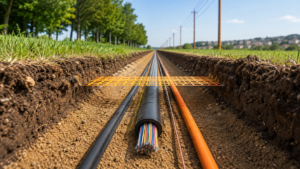
Microtrenching gets an engineering ceiling. BICSI G3-2026 governs underground pathway design, civil engineering safety, and asset longevity for OSP construction. Its updated guidelines set firmer parameters around microtrenching depths and high-density innerduct layouts — the installation method operators have leaned on to cut per-foot costs in dense urban buildouts. The standard doesn’t ban the practice; it narrows the tolerance within which it can be performed.
HASB installation is heading toward standardized testing. The draft BICSI D055, D056, and D057 standards target High Air Speed Blowing and duct installation specifically. Once finalized, they would set defined thresholds for cable crash testing, maximum jetting pressures, and post-installation proofing — areas where, until now, quality control has varied significantly by installer and region.
NEC 2026 draws a harder line between limited-energy and power systems. NFPA 70’s 2026 edition restructures how optical fiber raceways and pathway grounding are classified, including new grounding and bonding requirements for limited-energy systems and clearer separation rules where fiber and power pathways coexist in shared trays or rooms. In practical terms, jurisdictions are expected to enforce ICT installations with the same rigor previously reserved for power wiring — documentation, listing compatibility, and inspection walk-throughs included.
Conduit manufacturing tolerances tighten. ASTM F2160 sets manufacturing tolerances for solid-wall HDPE conduit based on controlled outer diameter. The 2025–2026 revision mandates stricter dimensional testing specifically to ensure reliability during high-tension pullbacks — the exact scenario long-haul HDD fiber installs depend on.
The math behind the pipe: PPI TN-50 / MS-5
The Plastics Pipe Institute’s TN-50 and MS-5 technical manuals provide the mathematical models contractors use to calculate pull-back tension and crush limits during HDD installation. Because these models take conduit OD tolerance as a direct input, the ASTM F2160 revision and the PPI guidance move together — tighter manufacturing tolerance narrows the safety margin engineers previously had to build into every pull-back calculation.
The Convergence Squeeze
The regulatory net is tightening exactly as fiber buildout accelerates, and that timing isn’t coincidental. Federally subsidized broadband expansion has driven a multi-year surge in OSP construction volume. Standards bodies are responding with codes built for higher-density, higher-speed installation rather than the slower, lower-volume builds of a decade ago.
BICSI G3-2026 marks a shift from “buried and forgotten” to “engineered for lifecycle.” By codifying strict depth and density parameters, it closes the gap where installers could minimize trenching costs at the expense of long-term cable protection. The practical effect: microtrenching stays viable, but only within tighter tolerances — raising per-foot compliance costs while reducing future maintenance liability.
The D055/D056/D057 series targets a bottleneck the industry has quietly lived with for years: verifying HASB installation quality at scale. As cable installation shifts from labor-intensive pulling to pneumatic jetting, the lack of standardized pressure thresholds has left installers exposed to inconsistent quality control and disputed liability after cable damage. Codifying these thresholds is less about innovation and more about risk transfer — giving the industry a fixed baseline against which damage claims can be adjudicated.
NEC 2026’s restructuring resolves years of ambiguity between conductive and nonconductive pathway classifications, disproportionately affecting hybrid fiber/copper builds — the dominant last-mile topology in real-world FTTx. Bringing fiber and limited-energy systems under clearer grounding and separation rules closes a long-standing gap that has historically complicated coordination between ICT and electrical trades on shared job sites.
ASTM F2160 and PPI TN-50/MS-5 together form the mathematical backbone of long-haul HDD economics. Tighter OD tolerance testing reduces the safety margin previously built into pull-back tension calculations, which can translate into longer maximum pull lengths per drill section — a meaningful cost lever, since every additional bore entry/exit point adds significant expense to rural and suburban HDD projects.
Taken together, these updates industrialize what was historically an artisanal trade. OSP/FTTx construction is moving from regionally inconsistent, installer-discretion-driven practice toward a documented, testable, liability-clear framework — echoing the maturation curve seen earlier in structured cabling and data center standards. Compliance overhead rises in the near term, but so does asset predictability and insurability — a trade-off that favors well-capitalized fiber operators over undercapitalized regional installers who may struggle to absorb the new testing and documentation burden.
Frequently Asked Questions
Does BICSI G3-2026 ban microtrenching?
No. It sets stricter depth and innerduct-density parameters for microtrenching rather than prohibiting it, meaning the method remains viable but requires tighter engineering compliance.
How does NEC 2026 affect existing fiber installations?
NEC 2026 primarily governs new construction and inspected work going forward; it restructures grounding and raceway classification rules that inspectors will apply to new permits and installations under the updated code.
Why does HDPE conduit tolerance matter for fiber installers?
Tighter outer-diameter tolerances under ASTM F2160 directly affect the pull-back tension and crush-limit calculations used in horizontal directional drilling, influencing how far cable can safely be pulled in a single drill section.
Closing Analysis
The BICSI D055/D056/D057 series remains in draft status, meaning final thresholds for HASB testing could still shift before adoption. What’s clear already is the direction: standards bodies are converging on documented, testable compliance across mechanical, electrical, and structural domains simultaneously — rather than one code updating in isolation. Operators and contractors evaluating 2026 build budgets should treat this cycle as a floor, not a ceiling, on what compliance will require going forward.