As organizations demand faster connectivity, lower operational costs, and infrastructure capable of supporting artificial intelligence, cloud computing, and massive Internet of Things (IoT) deployments, traditional copper cabling is rapidly reaching its practical limits.
One networking architecture is emerging as a preferred long-term solution across hospitals, universities, research laboratories, government facilities, and enterprise campuses: Fiber to the Edge (FTTE).
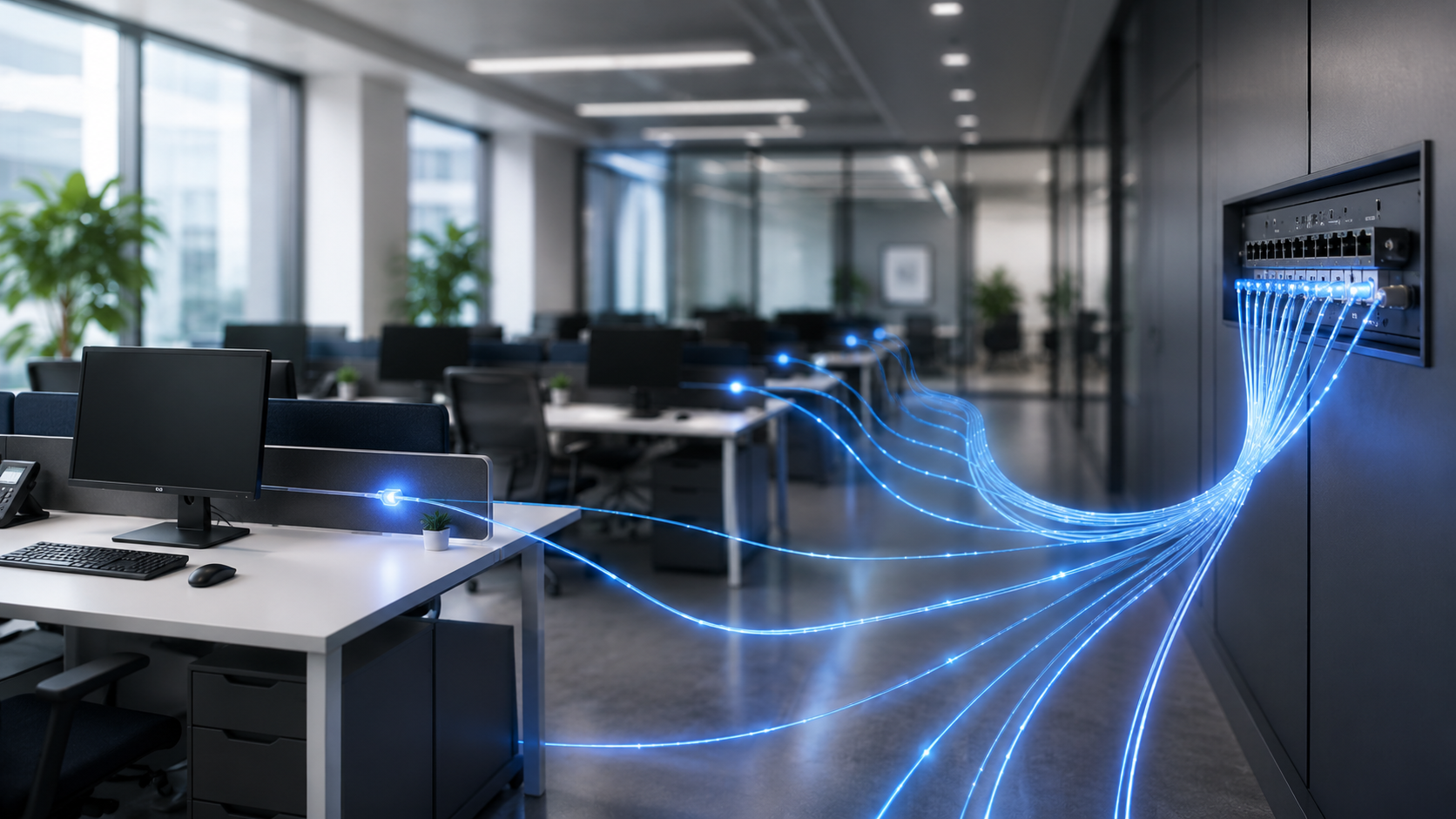
Rather than stopping fiber connections in telecommunications closets before transitioning to copper Ethernet, FTTE extends optical fiber directly to workspaces, access points, laboratories, and endpoint devices. The result is a network that’s faster, more reliable, significantly more secure, and designed to support decades of technological evolution.
What Is Fiber to the Edge (FTTE)?
Fiber to the Edge (FTTE) is an enterprise networking architecture that replaces traditional horizontal copper cabling with optical fiber extending directly to end-user environments.
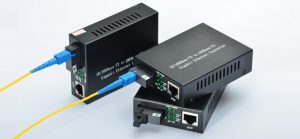
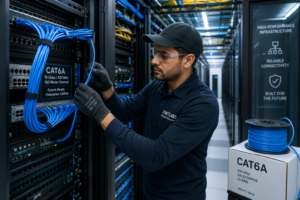
Instead of relying on Category 6 or Category 6A Ethernet cables for long-distance runs, organizations deploy either single-mode or multi-mode fiber directly from centralized network equipment to workspace outlets or compact media converters.
This architecture dramatically simplifies enterprise cabling while delivering virtually unlimited upgrade potential.
Why Organizations Are Adopting FTTE
Several technology trends are accelerating enterprise investment in fiber-first infrastructure.
Explosive Bandwidth Growth
Modern organizations increasingly rely on:
- AI-powered applications
- 8K video collaboration
- Cloud desktops
- High-resolution medical imaging
- Scientific simulations
- Digital twins
- Edge computing
- Real-time analytics
These workloads continue pushing network traffic beyond what legacy copper infrastructure was originally designed to support.
Fiber offers bandwidth capacity measured not merely in gigabits—but scalable into hundreds of gigabits and even terabits using upgraded optical equipment.
Immunity to Electromagnetic Interference (EMI)
Hospitals, manufacturing plants, airports, research centers, and industrial campuses often contain electrical equipment that produces significant electromagnetic interference.
Unlike copper Ethernet cables, optical fiber transmits data using light rather than electrical signals.
This makes FTTE completely immune to EMI, ensuring consistent performance even in electrically noisy environments.
Longer Cable Runs
Copper Ethernet typically requires intermediate telecommunications closets every 90 meters.
Fiber, however, supports connections spanning hundreds or even thousands of meters depending on the optical technology deployed.
This allows organizations to:
- Eliminate wiring closets
- Reduce switching hardware
- Lower cooling requirements
- Decrease power consumption
- Simplify maintenance
Improved Physical Security
Fiber is substantially more difficult to tap without detection compared to copper cables.
For government agencies, healthcare providers, financial institutions, and defense organizations, this additional security layer makes FTTE particularly attractive.
Lower Total Cost of Ownership
Although fiber historically carried a reputation for higher installation costs, that perception has changed considerably.
Modern fiber optic cabling is:
- Smaller
- Lighter
- Easier to install
- More durable
- Less expensive than previous generations
Organizations also reduce expenses by eliminating numerous network closets, reducing switch counts, lowering HVAC requirements, and simplifying cable management.
Across a building’s lifecycle, these operational savings often outweigh initial deployment costs.
Single-Mode vs. Multi-Mode Fiber
FTTE deployments generally rely on two primary fiber types.
Single-Mode Fiber
Ideal for:
- Large campuses
- Hospitals
- Government facilities
- Data centers
- Long-distance enterprise connections
Benefits include:
- Extremely long transmission distances
- Virtually unlimited upgrade path
- Lower signal attenuation
Multi-Mode Fiber
Best suited for:
- Office buildings
- Educational campuses
- Enterprise laboratories
- Medium-distance deployments
Benefits include:
- Lower transceiver costs
- Excellent high-speed performance
- Simplified installation for shorter runs
Industries Leading FTTE Adoption
Fiber to the Edge is expanding rapidly across sectors where reliability and scalability are mission-critical.
Healthcare
Hospitals increasingly deploy FTTE to support:
- Medical imaging
- Electronic health records
- Smart patient monitoring
- Connected surgical equipment
- AI-assisted diagnostics
Higher Education
Universities require resilient infrastructure capable of supporting:
- Thousands of student devices
- High-performance research computing
- Campus-wide Wi-Fi
- Virtual learning
- Scientific laboratories
Enterprise Research Facilities
Research organizations generate enormous datasets requiring reliable, low-latency connectivity between laboratories, storage systems, and compute clusters.
FTTE minimizes bottlenecks while providing future expansion capacity.
Smart Buildings
Modern commercial buildings increasingly integrate:
- IoT sensors
- Smart lighting
- Security cameras
- Building automation
- Occupancy monitoring
- Environmental controls
Fiber infrastructure provides the bandwidth required for these converged systems.
FTTE and the Future of AI Infrastructure
Artificial intelligence is reshaping enterprise networking requirements faster than almost any previous technology wave.
AI workstations, GPU clusters, edge inference systems, and high-speed storage all require infrastructure capable of moving massive volumes of data without latency bottlenecks.
Fiber to the Edge aligns naturally with these demands by delivering scalable optical connectivity that can evolve alongside future Ethernet standards without requiring wholesale cable replacement.
This makes FTTE an increasingly strategic investment for organizations planning long-term digital transformation initiatives.
Challenges to Consider
Despite its advantages, FTTE deployments require careful planning.
Organizations should evaluate:
- Existing infrastructure compatibility
- Optical transceiver costs
- Network management expertise
- Endpoint media conversion requirements
- Initial capital investment
However, these considerations are increasingly outweighed by long-term operational savings and future scalability.
The Bottom Line
Fiber to the Edge represents more than an incremental networking upgrade—it marks a fundamental shift in enterprise infrastructure design.
As bandwidth requirements continue to accelerate through AI, cloud computing, IoT, and increasingly connected workplaces, extending optical fiber directly to end-user environments offers organizations greater reliability, stronger security, lower lifecycle costs, and unmatched scalability.
For enterprises planning infrastructure that can remain relevant over the next several decades, FTTE is rapidly becoming one of the most compelling investments in modern networking.
Key Takeaways
- FTTE replaces horizontal copper cabling with fiber optic connections to end-user workspaces.
- Fiber eliminates electromagnetic interference (EMI), making it ideal for hospitals, laboratories, and industrial environments.
- Longer cable distances reduce the need for telecommunications closets and network hardware.
- FTTE lowers long-term operational costs while increasing scalability and energy efficiency.
- AI, IoT, cloud computing, and high-bandwidth applications are accelerating enterprise adoption of fiber-first networking.
FAQ
What is Fiber to the Edge (FTTE)?
Fiber to the Edge is a networking architecture that extends fiber optic cabling directly to end-user workspaces, replacing traditional copper Ethernet for horizontal cabling.
Why is FTTE better than copper?
FTTE offers higher bandwidth, longer transmission distances, immunity to electromagnetic interference, stronger physical security, and a more future-ready infrastructure.
Where is FTTE commonly deployed?
It is widely used in hospitals, universities, enterprise campuses, research laboratories, government facilities, smart buildings, and other environments with demanding network requirements.
Does FTTE reduce costs?
While installation costs can vary, FTTE often lowers total cost of ownership by reducing wiring closets, cooling needs, power consumption, and maintenance over the life of the network.
Is FTTE suitable for AI infrastructure?
Yes. FTTE provides the scalable, high-capacity connectivity needed for AI workstations, GPU clusters, edge computing, and data-intensive enterprise applications.