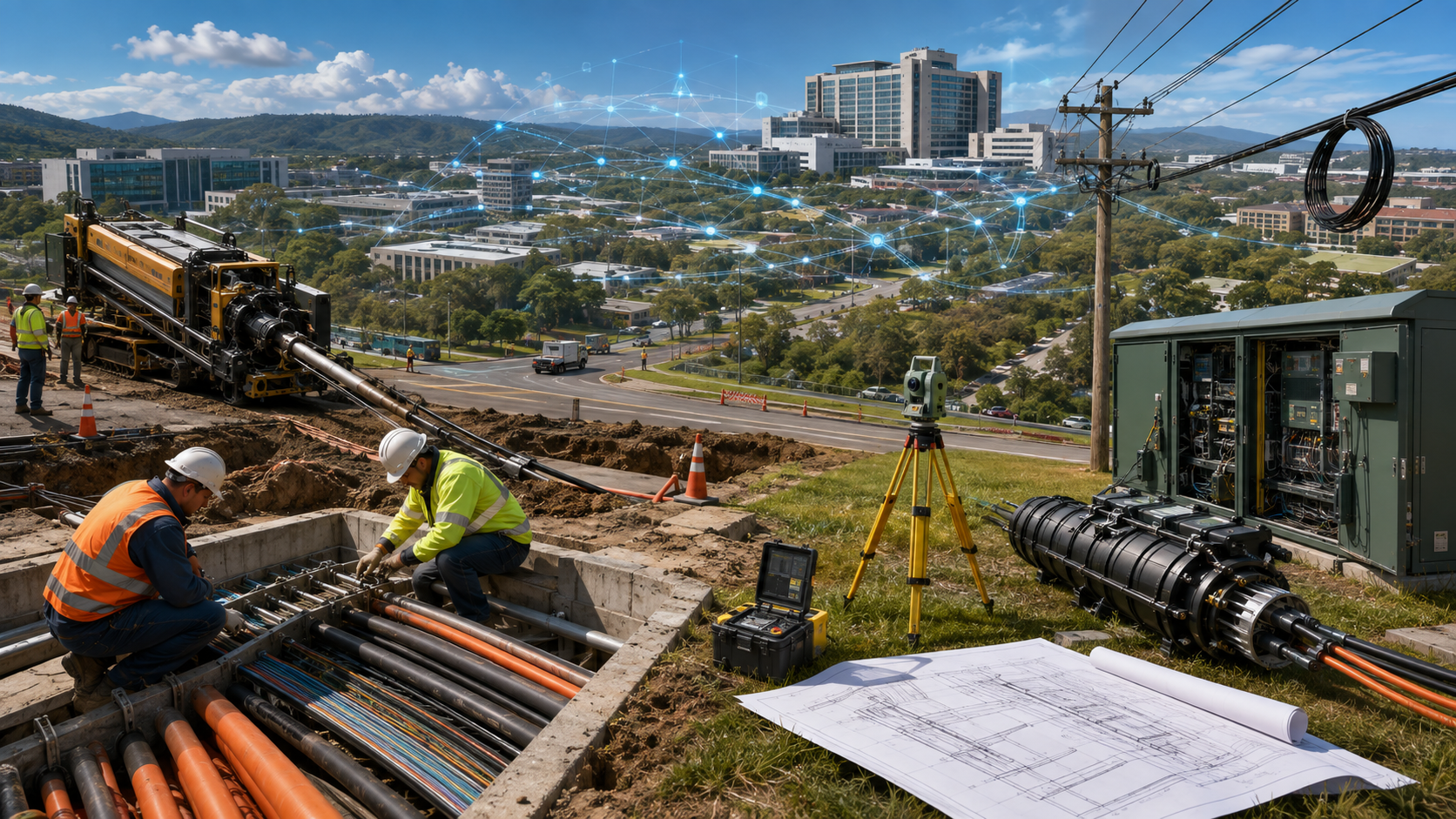
Chapter 1 Introduction to Outside Plant (OSP) Telecommunications Infrastructure
1.1 Purpose and Scope of This Handbook
This handbook provides authoritative guidance on the design, construction, installation, and lifecycle management of outside plant (OSP) telecommunications infrastructure. It is written for professionals holding or pursuing BICSI Registered Communications Distribution Designer (RCDD) and Outside Plant (OSP) Designer credentials, as well as ICT consultants and telecommunications engineers responsible for campus, carrier, utility, and government networks.
The content synthesizes current best practices and mandatory requirements drawn from BICSI publications (including the Outside Plant Design Reference Manual, 6th Edition, and the G-series construction and installation standards), ANSI/TIA-758-B (Customer-Owned Outside Plant Telecommunications Infrastructure Standard), IEEE C2-2023 (National Electrical Safety Code), relevant ICEA cable standards, FOA installation practices, the National Electrical Code (NFPA 70), OSHA regulations, and applicable federal, state, and local requirements. Emphasis is placed on practical application in multi-owner, multi-jurisdictional environments typical of modern campus, carrier backbone, utility, and government facilities.
Outside plant infrastructure forms the critical interbuilding and interfacility backbone that enables virtually all modern communications services. Failures or deficiencies in OSP design or construction frequently result in extended outages, high restoration costs, regulatory non-compliance, and liability exposure. Consequently, the OSP Designer must integrate technical, safety, environmental, regulatory, and commercial considerations from the earliest planning stages.
1.2 Definition of Outside Plant
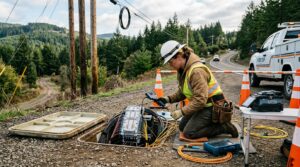
BICSI defines outside plant as the telecommunications infrastructure designed and installed externally to buildings and typically routed into an entrance facility (EF). OSP encompasses pathways, spaces, cabling media, connecting hardware, bonding and grounding systems, and associated support infrastructure located outside the building footprint.
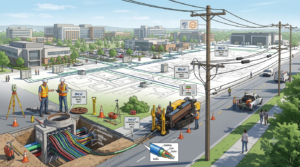
OSP pathways and spaces commonly include:
- Aerial systems (poles, strand, self-supporting cable)
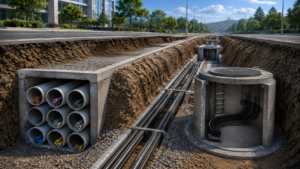
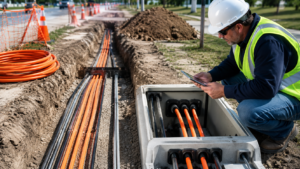
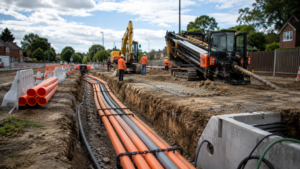
- Underground systems (duct banks, conduits, manholes, handholes, vaults)
- Direct-buried systems
- Tunnels, bridges, and other specialized routes
- Associated structures such as pedestals, cabinets, and splice enclosures
Cabling media within OSP environments include optical fiber (the predominant medium in contemporary networks), balanced twisted-pair copper, and coaxial cable. Hybrid and composite cables are also encountered, particularly in utility and carrier applications.
Customer-owned OSP (the primary focus of ANSI/TIA-758 and much of BICSI guidance) differs from service-provider or utility OSP in ownership, permitting regimes, and performance expectations, yet the underlying engineering principles and safety requirements remain closely aligned.
1.3 Scope Differentiation by Network Type
While fundamental OSP principles are common, application environments impose distinct requirements:
Campus Networks Typical of universities, corporate headquarters, hospitals, industrial parks, and multi-building government complexes. These networks are usually customer-owned, relatively short-haul, and must support high-bandwidth, low-latency applications while remaining under single or coordinated ownership. Pathway diversity, future capacity, and aesthetic considerations are frequently prioritized.
Carrier Networks Long-haul, metro, and access networks operated by telecommunications service providers. These systems emphasize high fiber counts, long span lengths, ruggedized cable constructions, and stringent reliability metrics. Joint-use arrangements, extensive right-of-way negotiations, and compliance with carrier-specific construction practices are routine.
Utility Networks Electric, gas, water, and other utility operators increasingly deploy OSP for SCADA, smart-grid, distribution automation, and internal communications. These networks often share corridors with power infrastructure, triggering heightened NESC clearance, bonding, and induction-mitigation requirements. Reliability and security expectations are exceptionally high.
Government and Defense Networks Federal, state, local, and military installations frequently require enhanced physical security, TEMPEST or Protected Distribution System (PDS) considerations, redundancy, and compliance with specialized specifications (e.g., Unified Facilities Guide Specifications). Multi-agency coordination and classified pathway requirements may apply.
The OSP Designer must correctly identify the ownership model, regulatory jurisdiction, and performance objectives at the outset of every project, as these factors drive pathway selection, media choice, documentation standards, and acceptance criteria.
1.4 Roles and Responsibilities of the OSP Designer / RCDD
The OSP Designer (or RCDD performing OSP design functions) is responsible for translating user requirements into a constructible, code-compliant, and maintainable infrastructure. Core responsibilities include:
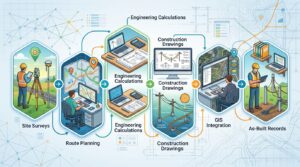
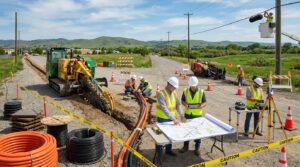
- Conducting or directing site surveys and existing-condition assessments
- Selecting pathways, spaces, and media based on performance, cost, risk, and future growth
- Preparing detailed design documents, specifications, and construction drawings
- Coordinating with civil, electrical, structural, and environmental disciplines
- Ensuring compliance with applicable codes, standards, and authority-having-jurisdiction (AHJ) requirements
- Addressing right-of-way, permitting, and joint-use issues
- Defining testing, acceptance, and documentation requirements
- Supporting construction administration, as-built verification, and turnover
In complex projects the OSP Designer frequently serves as the technical authority who balances competing stakeholder interests while protecting the long-term integrity of the telecommunications asset.
1.5 Evolution of OSP Technology and Practice
OSP infrastructure has evolved from predominantly copper aerial and buried plant supporting voice services to high-density optical fiber systems carrying multi-terabit traffic. Key developments relevant to current practice include:
- Transition from copper to optical fiber as the dominant medium, driven by bandwidth demand and immunity to electromagnetic interference
- Adoption of passive optical networks (PON), radio-frequency-over-glass (RFoG), and dense wavelength-division multiplexing in both campus and carrier environments
- Increased use of all-dielectric self-supporting (ADSS) cable and advanced aerial construction techniques
- Greater reliance on directional boring, micro-trenching, and air-assisted (blown) cable placement to minimize surface disruption
- Heightened attention to maintenance, restoration, and resilience following major weather events and the introduction of updated NESC storm-loading criteria
- Integration of geographic information systems (GIS) and digital twin concepts for asset management
- Growing emphasis on sustainability, reduced environmental impact, and shared infrastructure models
These advances are reflected in the successive editions of the BICSI Outside Plant Design Reference Manual and the expanding G-series of construction standards.
1.6 Relationship to Codes, Standards, and Best Practices
OSP design and construction operate within a hierarchical framework:
- Mandatory codes and regulations — National Electrical Safety Code (IEEE C2), National Electrical Code (NFPA 70), OSHA, environmental statutes, and local ordinances. These establish minimum safety requirements and are enforceable by law.
- Consensus standards — ANSI/TIA-758, BICSI G-series standards, ICEA cable standards, and related TIA component standards. These define performance and interoperability expectations.
- Industry best practices and recommended methods — BICSI technical manuals (particularly the OSPDRM), FOA installation guidance, manufacturer recommendations, and carrier or agency-specific practices. These often exceed minimum code requirements and represent the expected standard of care for professional designers.
Where conflicts arise, the more stringent requirement generally governs, subject to AHJ interpretation. The competent OSP Designer maintains current knowledge of all three layers and documents the basis for design decisions.
1.7 Key Considerations for Professional Practice
Successful OSP projects share several characteristics:
- Early and continuous stakeholder engagement, including property owners, utilities, municipalities, and environmental authorities
- Rigorous site investigation and utility coordination (including 811 one-call procedures)
- Explicit treatment of future capacity, pathway diversity, and maintainability
- Comprehensive documentation suitable for construction, operation, and future expansion
- Integration of safety, environmental protection, and risk management throughout the project lifecycle
Deficiencies in any of these areas frequently lead to change orders, delays, or long-term operational problems.
1.8 Organization of Subsequent Chapters
The remaining chapters of this handbook develop the topics introduced here in greater technical detail. Pathway and space design (underground, direct-buried, and aerial) receive dedicated treatment aligned with the current BICSI G-series standards. Subsequent chapters address media selection, bonding and grounding, right-of-way and permitting, the formal design process, construction methods, testing and acceptance, maintenance and restoration, and specialized applications. Appendices provide checklists, reference matrices, and supporting tools intended for daily professional use.
Mastery of the principles outlined in this chapter provides the foundation for the detailed design and implementation guidance that follows.