Key Takeaways
- Gel-filled cables use a continuous hydrophobic gel barrier; dry-water-blocked cables use Super Absorbent Polymer (SAP) that only activates — swelling up to 200 times its dry weight — when it contacts water.
- Both designs meet the same environmental standards, such as Telcordia GR-20 and IEEE 1222, but achieve moisture protection through opposite mechanisms: passive barrier versus active chemical expansion.
- Dry-core prep cuts buffer tube cleaning time from roughly 10 minutes per tube (gel) to under 3 minutes per tube (dry) — a savings of 1.5–2 hours across a full 144-fiber splice point.
- Dry cables eliminate solvent-based degelling, removing VOC exposure and hazardous waste from confined splice environments.
- Dry cables are also up to 20% lighter, which can extend allowable spans and ease cable-pulling logistics.
Why the Water-Blocking Method Still Matters
Outside plant (OSP) fiber technicians rarely get to choose which cable shows up on a given job — but knowing which type they’re facing changes almost every step of splice prep. The core question isn’t whether a cable resists water intrusion; both gel-filled and dry-water-blocked designs are certified to it. The question is how that resistance is engineered, because that choice cascades into prep time, consumables, safety exposure, and even how much cable a crew can pull in a day.
Two Engineering Philosophies
Gel-filled (wet-core) cables flood the loose buffer tubes and core voids with a viscous, petroleum- or silicone-based thixotropic gel. This creates a continuous physical barrier against water migration while letting the fibers “float” inside the tube, decoupling them from external tension and compression.
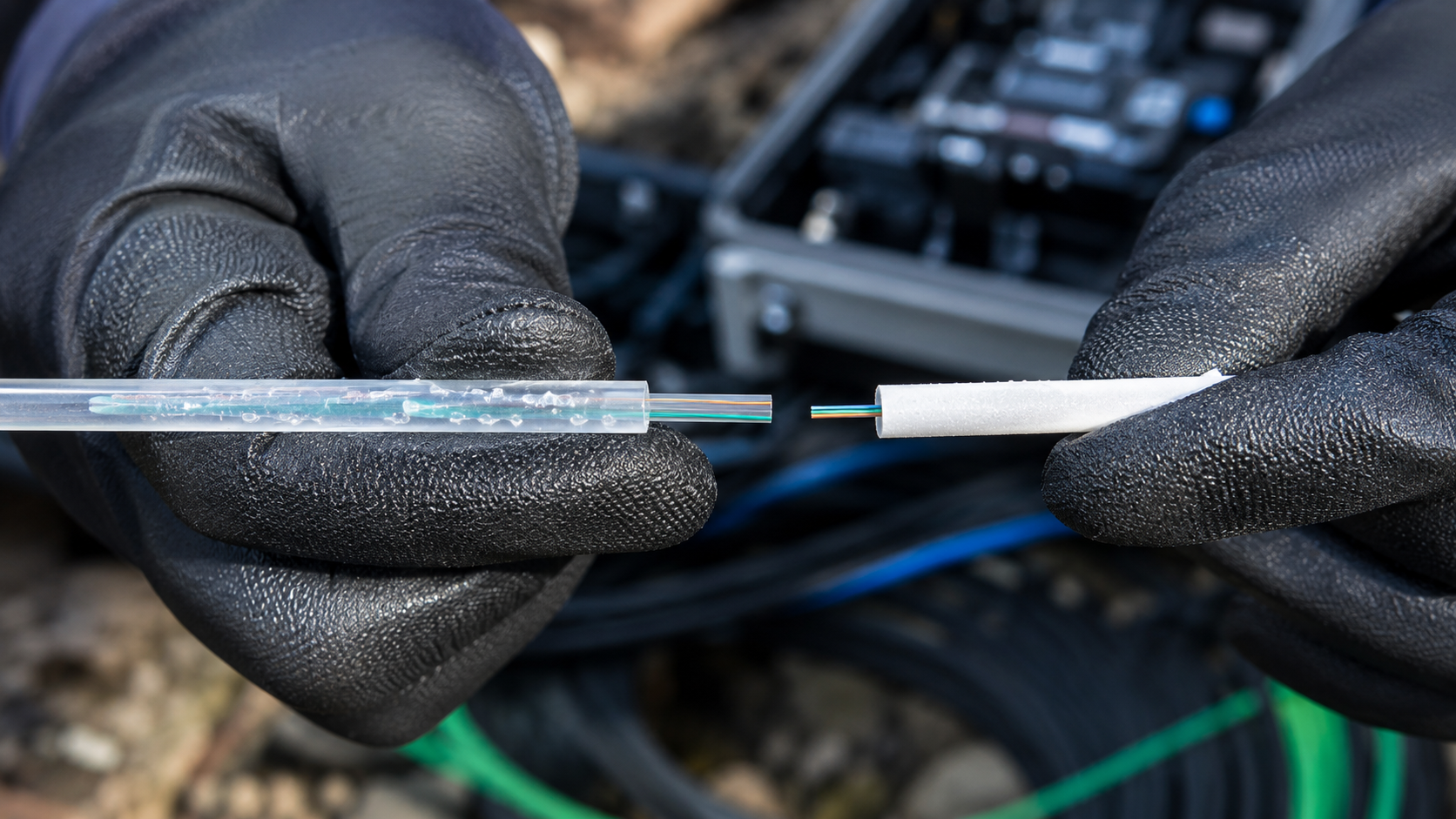
Dry-water-blocked (gel-free) cables take the opposite approach. Instead of a constant fluid barrier, they use Super Absorbent Polymer in powder, tape, or yarn form, wrapped around the internal structure. The SAP sits dormant until the sheath is breached — at which point it rapidly swells into a localized gel dam that seals off the breach.
Structural Comparison
| Attribute | Gel-Filled (Wet) Cable | Dry-Water-Blocked Cable |
|---|---|---|
| Water-blocking medium | Viscous hydrophobic gel | Dry SAP powder, yarns, or tapes |
| Moisture response | Passive continuous barrier | Active chemical expansion on contact |
| Mechanical tension handling | Fibers float in fluid | Relies on fiber excess length and bend-insensitive glass |
| Cable weight | Heavier | Up to 20% lighter |
| Splice prep time | Longer (solvent washes required) | Faster (dry mechanical stripping) |
| Ribbon matrix risk | Solvents can delaminate ribbon matrices | No solvent-related risk |
Field Time and Cost Impact
The prep-time gap is the number craft supervisors tend to care about most. Cleaning a 144-fiber gel-filled cable — 12 buffer tubes of 12 fibers each — runs about 10 minutes per tube to dissolve and wipe away flooding compound. The same tube on a dry-core cable takes under 3 minutes. Multiplied across a two-ended splice point, that’s an estimated 1.5 to 2 hours saved per closure.
Consumables tell a similar story. Wet-core prep burns through specialized solvents — degelling agents and precision fiber cleaners — plus large volumes of lint-free wipes, all of which become waste that has to be managed. Dry-core prep needs little beyond standard wipes to brush off loose SAP dust.
There’s also a safety dimension worth flagging for crews working in vaults or splice trailers: degelling solvents release volatile organic compounds that can build up in confined spaces, creating both skin-contact and inhalation exposure. Dry-core prep removes that exposure pathway entirely.
Step-by-Step: Gel-Filled Cable Prep
- Sheath and armor removal. Ring-cut the outer jacket at the marked strip length, flex to snap it, pull the ripcords to split jacket and armor, and cut the armor flush. Chemical-resistant gloves and eye protection are prerequisites.
- Core cleaning and strength member prep. Apply a heavy-duty gel solvent to paper towels and wipe down the central strength member and buffer tube exteriors to strip flooding compound, then trim the strength member to spec.
- Buffer tube ringing and extraction. Score the tube with a rotary cutter, flex to snap, and slide it off in short increments to avoid kinking the fibers inside.
- Chemical fiber degelling. Wipe the exposed fiber bundle outward — never back toward the tube — with a precision fiber cleaner until fibers fan freely and no longer cling together.
- Cleaving and fusion splicing. Strip the acrylate coating to bare 125-micron glass, wipe once with 99% IPA, cleave, and fuse.
Step-by-Step: Dry-Water-Blocked Cable Prep
- Sheath and armor removal. Because there’s no flooding compound underneath, the split jacket and armor slide off cleanly after ring-cutting and pulling the ripcords.
- Water-swellable material extraction. Snip and peel back the dry SAP tapes or binder yarns with scissors or Kevlar shears — no solvents needed — then cut the strength member to length.
- Buffer tube ringing. Score and snap the dry tube; it slides off with less friction than a gel-filled tube since there’s no internal vacuum.
- Mechanical dusting and fanning. Snip away the SAP yarns and sweep off any residual powder with a dry lint-free wipe — no chemical degelling step.
- Cleaving and fusion splicing. Strip, clean with IPA, cleave, and fuse — identical final step to the wet-core process.
FAQ
Do gel-filled and dry-water-blocked cables meet the same performance standards? Yes. Both designs are commonly certified to standards such as Telcordia GR-20 or IEEE 1222; the difference is the mechanism, not the compliance bar.
Is dry-core cable always faster to splice? In prep time, generally yes — dry-core buffer tube cleaning is cited at under 3 minutes per tube versus roughly 10 minutes for gel-filled tubes. Cleave and fusion steps themselves are identical across both cable types.
Can solvents used on gel-filled cable damage the fiber? Improper use is a known risk factor — cleaning solvents can delaminate ribbon matrices if not handled correctly, which is one reason dry-core designs are positioned as lower-risk for ribbon cable applications.
Why would a network operator still choose gel-filled cable? Gel-filled designs let fibers float freely in a fluid medium, which decouples them from external mechanical tension and compression — a property some installations still prioritize over the labor and safety advantages of dry-core.
Closing Analysis
The wet-versus-dry divide isn’t a story of one design being obsolete — it’s a tradeoff between fluid-based mechanical decoupling and labor/safety efficiency, and different network builds will keep weighing that tradeoff differently. What’s worth watching is how quickly SAP-based dry-core designs continue displacing gel-filled cable in new OSP builds, given the compounding advantage of faster splice times, lighter reels, and reduced VOC exposure in confined vaults. Crews standardizing training and tool kits around one method over the other should expect the prep-time and consumables gap to keep shaping that decision.