The networking industry has quietly crossed a major milestone that every IT executive, network architect, systems integrator, and commercial building owner should recognize:
The era of installing Category 6 (Cat6) in new commercial buildings is effectively over.
Across enterprise campuses, hospitals, universities, manufacturing facilities, government offices, and smart buildings, Category 6A (Cat6A) has become the new minimum specification for structured cabling infrastructure.
This shift isn’t driven by marketing—it reflects the increasing demands of modern enterprise networking, high-power PoE deployments, Wi-Fi 7, AI-enabled workplaces, edge computing, and long-term infrastructure planning.
Why Cat6 Is No Longer Enough
For years, Cat6 represented the sweet spot between performance and cost.
It comfortably supported Gigabit Ethernet while providing limited support for 10 Gigabit Ethernet over shorter distances.
However, enterprise requirements have evolved dramatically.
Today’s commercial networks require infrastructure capable of supporting:
- 10 Gigabit access switches
- Wi-Fi 6E and Wi-Fi 7 access points
- High-resolution surveillance systems
- AI-powered security devices
- Digital signage
- Smart lighting
- Building automation
- Industrial IoT
- Unified communications
- High-power PoE devices
These technologies push legacy Cat6 installations to their limits.
Cat6A: The New Enterprise Baseline
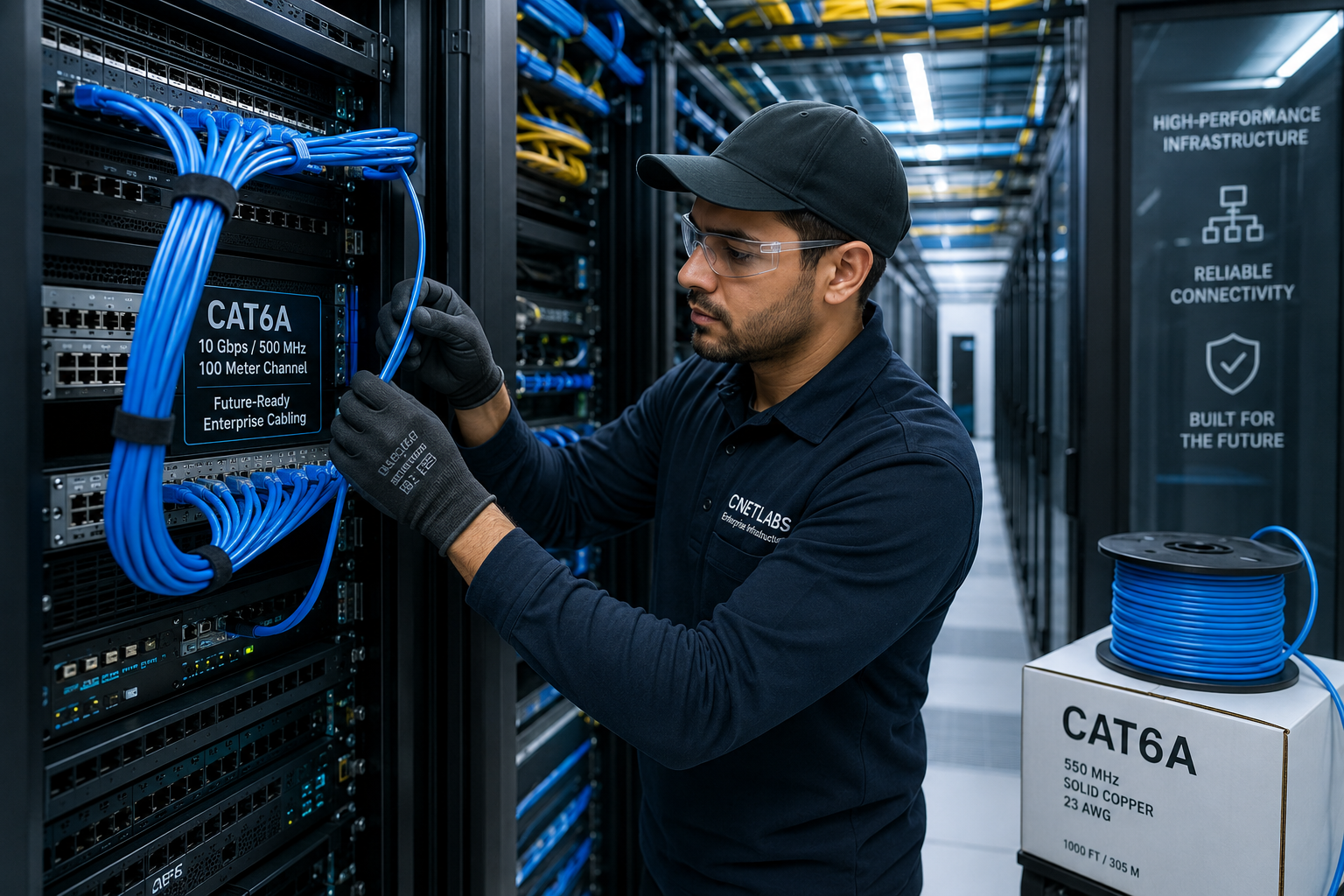
Unlike Cat6, Category 6A reliably supports:
✅ 10 Gbps Ethernet
✅ Full 100-meter channel length
✅ Better protection against alien crosstalk
✅ Higher bandwidth (500 MHz)
✅ Improved thermal performance
Perhaps the biggest advantage is its ability to handle today’s increasingly demanding Power over Ethernet (PoE) deployments.
As organizations deploy devices requiring 60W, 90W, or higher PoE power budgets, cable heating becomes a serious engineering concern.
Cat6A’s larger conductors and improved construction help reduce heat buildup inside large cable bundles, making it the preferred choice for high-density commercial installations.
Why Power over Ethernet Is Driving the Transition
Modern commercial buildings are becoming increasingly dependent on PoE.
Instead of running separate electrical circuits, organizations now power devices directly through Ethernet cables.
Examples include:
- Wi-Fi access points
- Security cameras
- VoIP phones
- Smart LED lighting
- Access control systems
- Occupancy sensors
- Environmental monitoring
- Digital displays
Each generation consumes more power than the last.
Using Cat6A significantly improves long-term reliability when supporting IEEE 802.3bt PoE standards delivering up to 90 watts.
Data Centers Are Moving Beyond Cat6A
Inside modern data centers, another transition is already well underway.
For high-speed switch-to-server connections, Category 8 has become the preferred copper solution.
Cat8 supports:
- 25 Gigabit Ethernet
- 40 Gigabit Ethernet
- Up to 2 GHz bandwidth
- Exceptional shielding
- Reduced electromagnetic interference
The trade-off is distance.
Unlike Cat6A, Cat8 is designed for runs of up to approximately 30 meters, making it ideal for top-of-rack deployments rather than building-wide installations.
Why Cat8 Excels in Modern Data Centers
Today’s AI clusters, virtualization platforms, and hyperconverged infrastructure demand ultra-fast, low-latency connectivity.
Cat8 provides:
- Faster server interconnects
- Lower latency
- Higher throughput
- Better shielding
- Simplified migration to higher-speed Ethernet
For organizations that still rely on copper connectivity within racks, Cat8 delivers a cost-effective alternative before transitioning entirely to fiber optics.
Future-Proofing Enterprise Infrastructure
Structured cabling is one of the longest-lived investments inside any commercial building.
Switches may be replaced every five years.
Wireless access points every four to six years.
Servers every three to five years.
But structured cabling often remains in service for 15 to 25 years.
Installing Cat6 today may save a small amount upfront but can create expensive limitations as organizations adopt:
- Wi-Fi 7
- Multi-gig switching
- AI edge computing
- Smart building technologies
- Higher-power PoE devices
- Advanced surveillance
- Real-time analytics
Cat6A provides greater flexibility and significantly reduces the likelihood of costly recabling projects later.
Enterprise Buying Considerations
When planning new commercial construction or major renovations, decision-makers should evaluate:
| Requirement | Recommended Cabling |
|---|---|
| Standard Office Buildings | Cat6A |
| Hospitals | Cat6A |
| Universities | Cat6A |
| Government Facilities | Cat6A |
| Smart Buildings | Cat6A |
| Manufacturing Plants | Cat6A |
| Data Center Top-of-Rack | Cat8 |
| Backbone Infrastructure | Single-Mode Fiber |
Industry Outlook
Industry analysts expect Cat6A to remain the dominant copper cabling standard throughout the remainder of the decade, particularly as organizations continue investing in AI-ready campuses, smart buildings, and higher-speed access networks.
Meanwhile, Category 8 will continue expanding within specialized data center environments where short-distance, high-bandwidth copper links remain practical. For longer-distance backbone connectivity and speeds beyond 40 Gbps, single-mode fiber continues to be the preferred medium.
Key Takeaways
- Cat6 is no longer recommended for new commercial enterprise installations.
- Cat6A is now the minimum standard for future-ready structured cabling.
- Cat6A reliably delivers 10 Gbps over the full 100-meter channel.
- It offers superior thermal performance for high-power PoE deployments.
- Category 8 is the preferred copper option for short-distance 25G and 40G data center connections.
- Organizations planning infrastructure that will last 15–25 years should prioritize Cat6A or fiber depending on application requirements.