11.1 Purpose and Scope
Even the best design fails if construction and installation are poorly executed. This chapter addresses the practical methods, safety requirements, quality controls, and acceptance criteria used to turn OSP designs into reliable operating infrastructure. Guidance is drawn from the BICSI G-series standards (G1, G2.1-22, G2.2-22, G3-2026, G4-23), the Outside Plant Design Reference Manual (OSPDRM) 6th Edition, the FOA Standard for Installing Fiber Optic Cable Plants (2025), OSHA regulations, NESC work rules, and current industry practice as of 2026.
11.2 Pre-Construction Requirements
Before work begins, the following must be in place:
- Approved construction drawings and specifications
- All required permits and right-of-way authorizations
- One-call (811) notifications and utility locates
- Traffic-control and safety plans
- Material submittals and approved products
- Pre-construction meeting with the owner, designer, constructor, and key stakeholders
Clear communication of roles, hold points, and inspection requirements reduces field conflicts.
11.3 Pathway Construction Methods
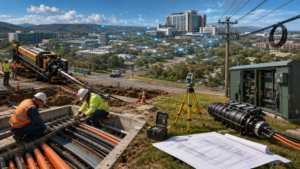
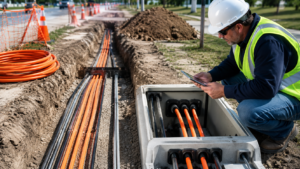
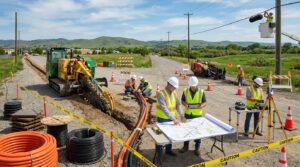
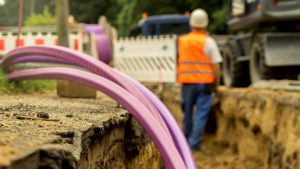
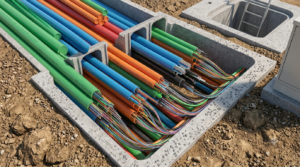
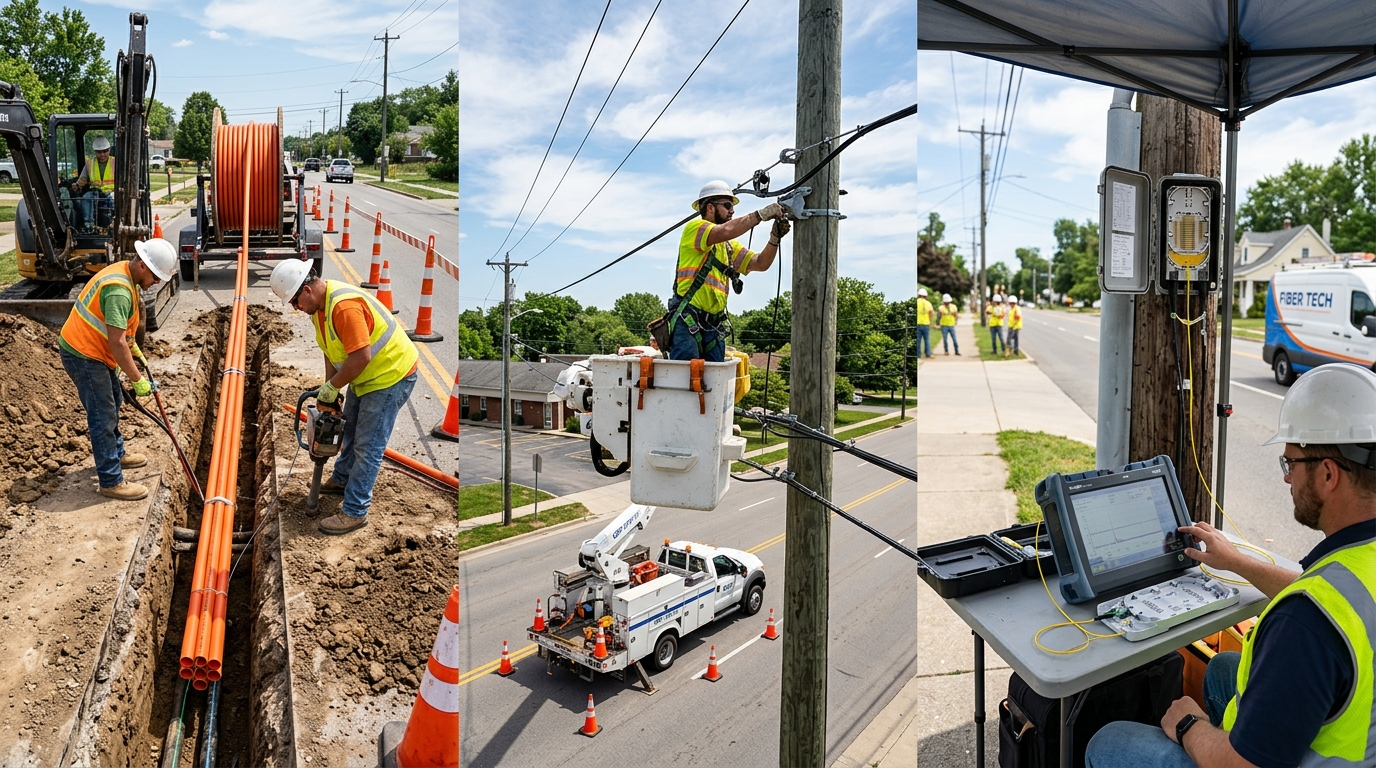
Underground (Duct and Manhole Systems) Methods include open-cut trenching, directional boring, and, where appropriate, micro-trenching. Conduits are placed to design alignment and depth, joined with compatible fittings, and sealed. Manholes and handholes are set to grade with proper bedding, drainage, and grounding. Mandrel testing of conduits is performed before cable placement. BICSI G3-2026 provides current general practices for underground facilities.
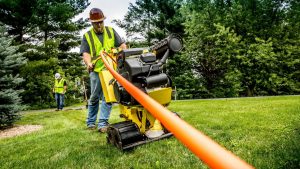
Direct-Buried Cable or continuous conduit is placed by trenching, plowing, or boring. Depth, warning tape, tracer systems, and select backfill must meet design and NESC requirements. BICSI G4-23 details placement methods, transitions, and restoration.
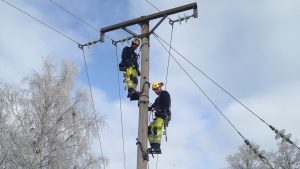
Aerial Poles are set, anchored, and guyed per BICSI G2.1-22. Messenger strand is installed and tensioned, followed by cable lashing or placement of self-supporting (ADSS) cable per BICSI G2.2-22. Clearances and tensions are verified under NESC loading conditions.
All methods require strict adherence to OSHA excavation, fall-protection, and aerial-work rules, as well as NESC work rules for communications facilities.
11.4 Cable Placement Methods
- Pulling — Conventional winch or capstan pulling in ducts. Tension and sidewall pressure must remain within manufacturer limits. Intermediate assist points and proper lubrication are used as needed.
- Air-Assisted (Blown) Placement — Increasingly common for micro-cables and high-density duct systems. Requires compatible cable, duct, and blowing equipment. High-air-speed blowing practices are an active area of BICSI standards development (D056).
- Plowing and Direct Burial — Used for suitable direct-buried routes; cable must be protected from damage during placement.
- Aerial Lashing and ADSS Installation — Controlled tension, proper lashing wire, and protection of cable at poles and transitions are essential.
Minimum bend radius must be observed at all times. Cable ends are sealed against moisture until spliced or terminated.
11.5 Splicing, Termination, and Slack Management
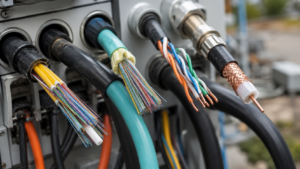
Splices (fusion preferred for single-mode) are performed in clean conditions and protected in appropriate closures. Slack storage is provided at design locations for future maintenance and restoration. Terminations at building entrances transition from outdoor-rated to indoor-rated cable in accordance with NEC requirements. All splices and terminations are documented.
11.6 Safety
Construction safety is non-negotiable. Key requirements include:
- Compliance with OSHA 29 CFR 1910 and 1926 (including telecommunications-specific rules)
- NESC Part 4 work rules
- Competent-person oversight of excavations
- Fall protection for aerial work
- Traffic control and public protection
- Personal protective equipment appropriate to the hazards
- Emergency response planning
Job briefings and continuous hazard assessment are standard practice.
11.7 Quality Assurance and Inspection
Quality is achieved through a combination of:
- Qualified personnel (BICSI or FOA credentials preferred for critical tasks)
- Material verification against approved submittals
- In-process inspection at defined hold points (conduit placement, cable placement, splicing, etc.)
- Adherence to manufacturer installation instructions
- Cleanliness and workmanship standards (“neat and workmanlike manner”)
The FOA Installation Standard and BICSI G-series provide practical benchmarks for workmanship.
11.8 Testing and Acceptance
Acceptance testing typically includes:
- Continuity and polarity verification
- Insertion-loss (power-meter) testing of installed fiber spans
- OTDR testing for length, splice quality, and fault location
- Verification of copper or coaxial performance where applicable
- Visual inspection of pathways, spaces, bonding, and labeling
- Confirmation that as-built conditions match approved design (or documented changes)
Test results are recorded and compared against design budgets and specified acceptance criteria. Failed tests require corrective action and re-testing before acceptance.
11.9 Restoration and Site Cleanup
Surfaces, pavements, landscaping, and drainage must be restored to equal or better condition. Temporary facilities are removed, and the site is left clean and safe. Final inspection confirms completion of all restoration work.
11.10 Documentation of Construction
Daily reports, inspection records, test results, photographs, and red-line drawings form the basis for final as-built documentation. Accurate records are essential for future maintenance and capacity management.
11.11 Summary
Construction and installation convert design intent into physical infrastructure. Success depends on qualified personnel, adherence to the BICSI G-series and FOA installation practices, rigorous safety management, systematic quality assurance, and complete testing and documentation. When these elements are executed professionally, the resulting OSP plant meets the reliability and longevity expectations of campus, carrier, utility, and government networks.
FAQ
What is OSP construction?
OSP construction is the field construction of telecommunications infrastructure located outside buildings, including ducts, conduits, manholes, handholes, aerial facilities, poles and fiber optic cable systems.
What are the main OSP fiber installation methods?
Common methods include conventional pulling, air-assisted or blown fiber placement, direct burial, plowing, directional boring and aerial installation.
What testing is required for installed fiber optic cable?
Typical acceptance testing includes continuity and polarity verification, insertion-loss testing with a power meter and light source, and OTDR testing to evaluate fiber length, splice performance and potential faults.
Why is OTDR testing important in OSP construction?
OTDR testing helps identify fiber length, splice events, connector events and abnormal losses or reflections, making it useful for commissioning, troubleshooting and documenting installed fiber spans.
What is quality assurance in OSP construction?
OSP quality assurance is the systematic inspection and verification of materials, construction methods, workmanship, testing and documentation to confirm that completed infrastructure complies with approved design and specified acceptance criteria.
Why are as-built drawings important?
As-built documentation records the infrastructure actually installed, including approved field changes, cable routes, splice information and construction details. It provides essential information for future maintenance, expansion and troubleshooting.