Key takeaways
- Standard Dimension Ratio (SDR) is the outside-diameter-to-wall-thickness ratio that trades crush resistance against usable internal space; SDR 11 is the HDD standard, SDR 17 maximizes bore for microtrenching and innerduct.
- Cable-to-conduit fill ratio should stay under 40% for conventional pulling, but jetting/HASB installs can safely run 35–50% fill because moving air, not a winch, carries the cable.
- The jam ratio (conduit ID ÷ cable OD) between roughly 2.8 and 3.2 is a documented danger zone where three equal-size cables wedge into a triangular lock inside a bend — a geometry problem, not a strength problem.
- Coefficient of friction swings from 0.35–0.40 on dry, unlubricated HDPE to as low as 0.08–0.12 with pre-lubricated innerduct, which is often the difference between a completed pull and a stuck cable at the mid-point of a long run.
Choosing HDPE conduit is rarely a single decision — it’s four interlocking calculations that have to agree with each other before a cable ever goes in the ground. Get one variable wrong and the other three don’t save you: a conduit sized correctly for fill ratio can still jam three cables in a bend, and a low-friction innerduct doesn’t help if the wall is too thin for the pullback tension of an HDD bore.
SDR selection sets the ceiling on everything else
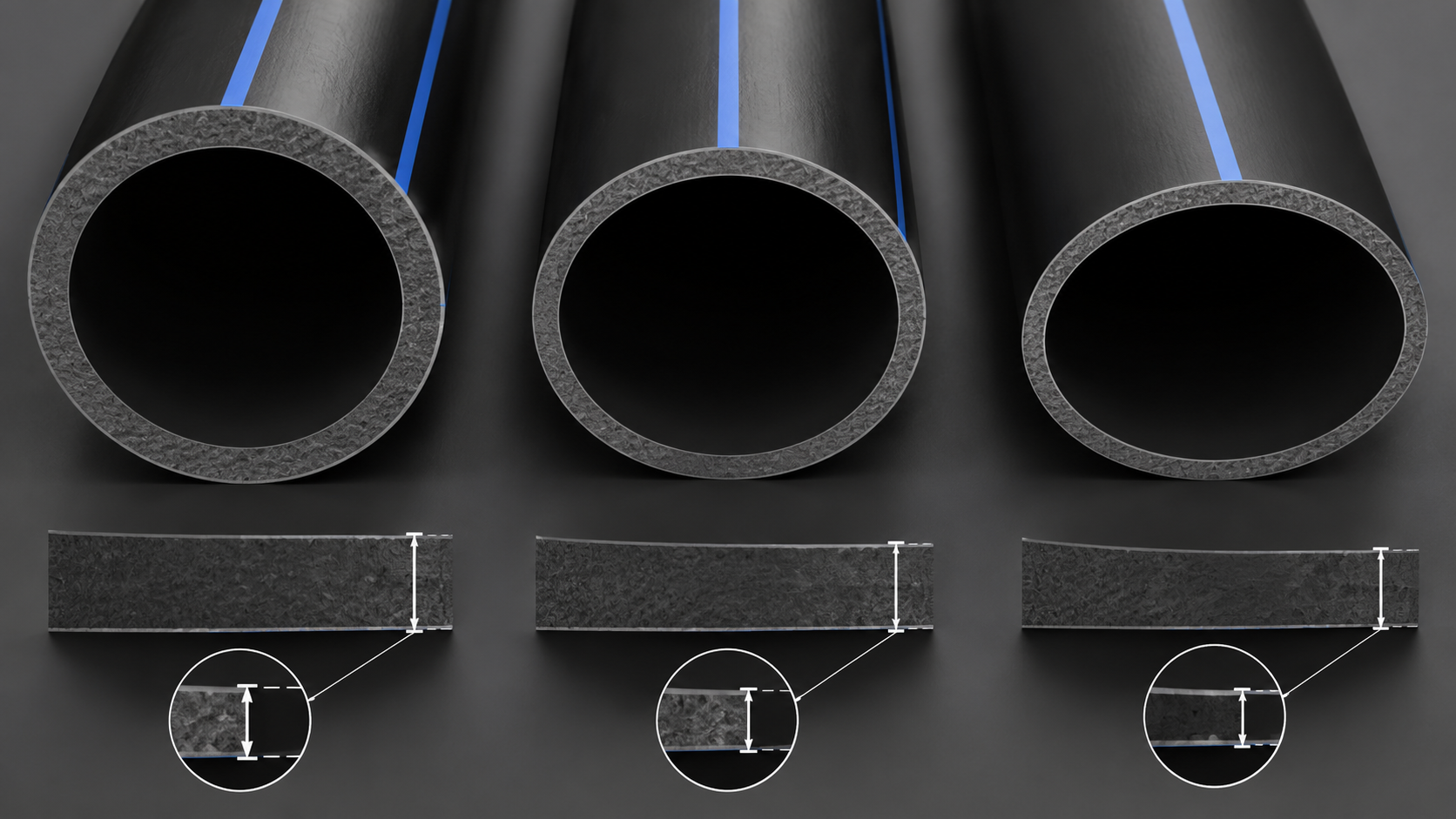
SDR (Standard Dimension Ratio) is calculated as outside diameter divided by wall thickness. A lower SDR number means a thicker wall — more tensile strength and crush resistance, but less usable inside diameter for a given outer pipe size.
That inverse relationship is why SDR selection is really a site-conditions decision, not a cost decision:
- SDR 11 is the default for HDD bores and rocky or heavy-traffic direct burial, where pullback tension and soil load are the binding constraints.
- SDR 13.5 fits stable-soil open trenching, trading some crush margin for more internal cross-section.
- SDR 17 is reserved for shallow trenching, microtrenching, concrete-encasement, or as innerduct nested inside a heavier outer casing — situations where an outer structure or shallow burial already does the protective work, freeing SDR 17 to maximize bore diameter instead.
Fill ratio changes depending on how the cable actually goes in
The 40% fill ceiling most installers know is a pulling-specific number. HASB (jetting) installs behave differently because air, not tension, is doing the work of moving the cable forward — which is why the safe fill window shifts up to 35–50%. Too little fill and there isn’t enough cable mass for the airflow to grip; too much and there’s no clearance for air to pass and carry it.
The governing formula:
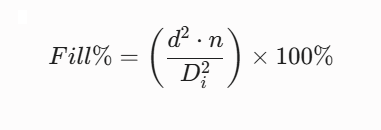
Where d is cable OD, n is cable count, and D_i is conduit inside diameter. Note this is an area ratio, not a diameter ratio — doubling cable diameter quadruples its share of the fill budget.
Jam ratio is a geometry trap that fill ratio alone won’t catch
This is the calculation most easily missed, because a conduit can pass its fill-ratio check and still fail on jam ratio. The two are unrelated: fill ratio measures area, jam ratio measures a diameter relationship that only matters when exactly three equal-size cables are pulled together.
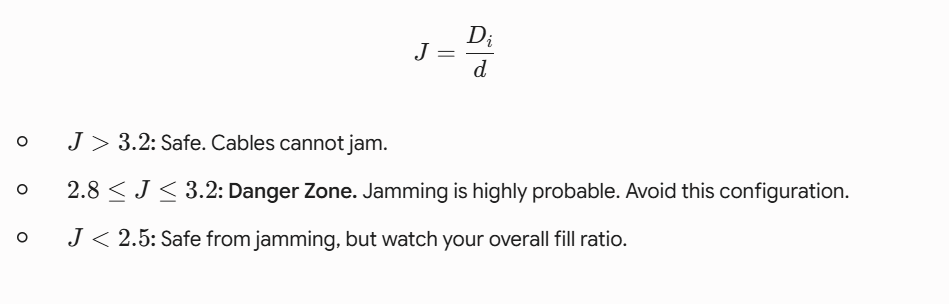
Industry references — including NEC informational notes and cable manufacturers’ pulling guides — consistently flag J between 2.8 and 3.2 as the danger zone. Below roughly 2.5 the three cables stay in a stable triangular “cradle” that can’t flatten; above about 3.2 there’s enough clearance that they never wedge. Inside the 2.8–3.2 band, a bend forces the triangular bundle to splay into a flat, side-by-side line, and if the combined width matches the conduit’s inside diameter, the cables lock against the wall like a keystone. No amount of additional pulling tension fixes this — it usually worsens the wedge and can crush the cable’s insulation before the crew even realizes the pull has stalled.
The practical fix is upstream, at the design stage: resize the conduit or select a different cable OD so the ratio lands clearly outside the band, rather than trying to solve a jam mid-pull.
Coefficient of friction decides how far any of this can actually run
All the diameter math assumes the cable can be moved through the conduit at all. That depends on the coefficient of friction (CoF) between cable jacket and conduit wall — and the spread here is large enough to change project economics outright.
- Raw HDPE, dry: CoF of roughly 0.35–0.40.
- Raw HDPE with premium field lubricant: drops to about 0.15–0.20.
- Pre-lubricated innerduct (co-extruded silicone-core or specialized low-friction linings): CoF as low as 0.08–0.12.
Because pulling tension scales directly with CoF, moving from dry HDPE to pre-lubricated innerduct can multiply the maximum feasible pull length several times over for the same tension budget — which is why pre-lubricated innerduct commands a price premium but often eliminates the need for costly intermediate pull vaults on long fiber runs.
Why these four numbers have to be solved together
SDR determines the inside diameter you have to work with. Fill ratio and jam ratio both consume that inside diameter — one by area, one by geometry — often pulling toward opposite conclusions. A conduit sized generously to avoid a jam-ratio problem may then run under the optimal HASB fill window, sacrificing installation speed. Coefficient of friction is the variable that recovers the margin lost elsewhere: a tighter, jam-ratio-safe conduit paired with pre-lubricated innerduct can still hit long-run pull targets that raw HDPE couldn’t achieve even in a looser-fitting duct.
This is the calculation gap that shows up most often in the field: designs that check fill ratio against pulling standards but never run the jam-ratio math for three-cable pulls, or that spec standard SDR 11 duct without pricing pre-lubricated innerduct against the cost of an extra mid-run pull vault. Getting all four variables to agree at the design stage is materially cheaper than discovering the conflict with 200 feet of cable stuck in a bend.
Frequently Asked Questions
What SDR is best for horizontal directional drilling?
SDR 11 is the standard choice for HDD because its thicker wall provides the tensile strength and crush resistance needed to withstand high pullback forces and surrounding soil pressure during the bore.
What is a safe jam ratio for pulling three cables?
A jam ratio above roughly 3.2, or below about 2.5, is considered safe; the range between 2.8 and 3.2 is the documented danger zone where three equal-size cables can wedge in a conduit bend.
Does fill ratio work the same way for jetting as for pulling?
No — conventional cable pulling targets a maximum 40% fill ratio, while HASB/jetting installations use a wider 35–50% window since moving air, rather than pulling tension, carries the cable through the duct.
Closing Analysis
The open variable across all four calculations is field verification: OD tolerances on both cable and conduit shift slightly from spec sheet to delivered product, and a jam ratio or fill ratio calculated on nominal dimensions can land closer to a danger zone than the design intended. Installers increasingly measure actual delivered diameters before finalizing conduit size, rather than trusting catalog values — a practice worth watching as tighter manufacturing-tolerance standards (like ASTM F2160) make nominal and as-built dimensions converge more reliably.