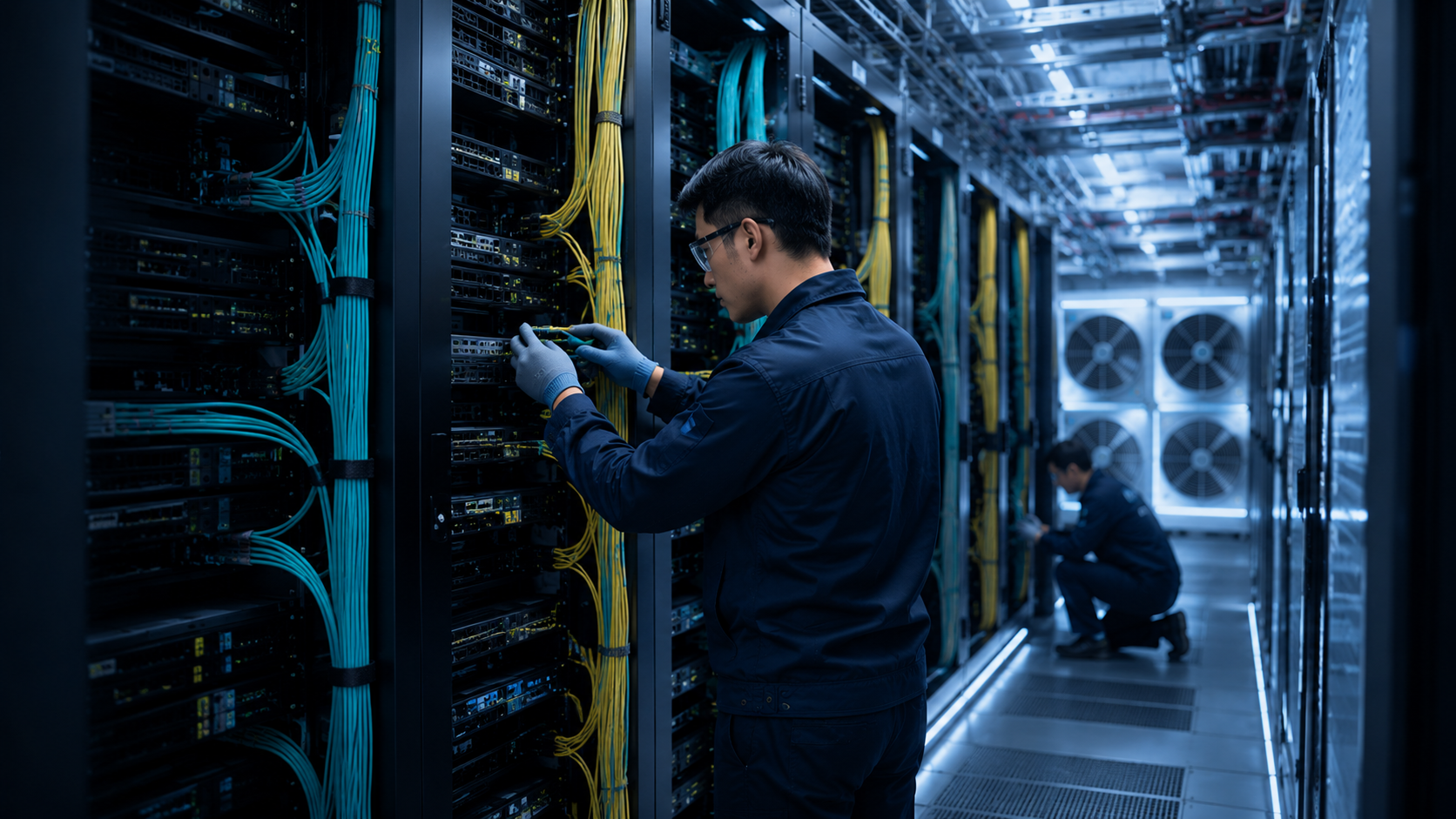
The explosive growth of artificial intelligence is transforming global digital infrastructure at a pace rarely seen in modern technology.
Hyperscale data centers—purpose-built facilities housing tens of thousands of servers—are now consuming more than ten times the amount of fiber optic cabling compared to conventional cloud facilities. The rapid expansion is forcing operators, network architects, and enterprise IT leaders to rethink how data centers are designed, cooled, and interconnected.
Industry analysts say the shift represents one of the most significant infrastructure upgrades since the rise of cloud computing.
AI Is Changing Everything
Traditional cloud data centers were designed primarily around CPU-based workloads that generated predictable traffic patterns.
Today’s AI infrastructure tells a very different story.
Massive GPU clusters used for training large language models, autonomous systems, scientific simulations, and enterprise AI applications require continuous high-speed communication between thousands of processors.
Every GPU node must exchange enormous volumes of data with neighboring nodes in milliseconds.
The result is an unprecedented increase in optical fiber deployment throughout modern facilities.
Rather than incremental upgrades, operators are redesigning entire network architectures to support next-generation AI workloads.
Why Fiber Demand Has Exploded
Several technological trends are driving this dramatic increase.
Higher GPU Density
Modern AI clusters can contain tens of thousands of GPUs operating simultaneously.
Each accelerator requires multiple high-speed optical connections for efficient communication.
This dramatically increases cable density throughout the facility.
East-West Traffic Growth
Unlike traditional internet traffic flowing between users and servers, AI workloads generate massive “east-west” traffic inside the data center.
Servers constantly exchange datasets, model parameters, and inference results.
These internal connections consume enormous amounts of optical bandwidth.
Higher Network Speeds
400G Ethernet has become increasingly common.
800G networking is rapidly expanding.
1.6 Tbps optical networking is already emerging for next-generation deployments.
Each increase requires more advanced fiber infrastructure capable of maintaining signal integrity over higher speeds.
Why Pre-Terminated Fiber Is Becoming the Industry Standard
Installing thousands of fiber links manually can require weeks of labor.
Pre-terminated fiber systems significantly reduce deployment time because cables arrive factory-tested with connectors already installed.
Benefits include:
- Faster installation
- Reduced labor costs
- Lower risk of connector contamination
- Improved cable management
- Faster expansion of AI clusters
- Reduced network downtime
For hyperscale operators where every hour of deployment delay represents lost computing capacity, these efficiencies can translate into substantial operational savings.
OM5 Fiber Gains Momentum
OM5 multimode fiber has become increasingly attractive for short-distance, high-bandwidth environments.
Advantages include:
- Higher bandwidth support
- Better compatibility with wavelength division multiplexing
- Reduced infrastructure complexity
- Support for future upgrades
- Lower total cost in selected deployments
However, many hyperscale providers continue investing heavily in single-mode fiber because it offers virtually unlimited scalability for future network generations.
Single-mode installations are expected to dominate backbone connectivity as AI infrastructure continues expanding.
Airflow Is Now as Important as Bandwidth
One unexpected consequence of AI computing is heat.
Modern GPU racks consume enormous electrical power.
Many exceed 100 kilowatts per rack.
This creates significant cooling challenges.
Large bundles of traditional fiber and copper cabling can obstruct airflow, reducing cooling efficiency.
High-density fiber solutions help minimize cable bulk, allowing cooling systems to operate more effectively.
Improved airflow directly contributes to:
- Lower operating temperatures
- Reduced cooling costs
- Improved equipment reliability
- Higher energy efficiency
- Longer hardware lifespan
Industry Standards Are Becoming Essential
As AI infrastructure becomes increasingly complex, standardized design practices are no longer optional.
Two frameworks are becoming particularly important.
ANSI/TIA-942
This internationally recognized data center infrastructure standard provides guidance for:
- Telecommunications spaces
- Cabling architecture
- Redundancy planning
- Pathway design
- Reliability classifications
- Infrastructure resilience
Organizations use the standard to build scalable, fault-tolerant facilities capable of supporting mission-critical operations.
BICSI 009
BICSI 009 focuses on practical design and operational best practices for modern data centers.
It addresses:
- Cable containment
- Pathway optimization
- Cooling strategies
- Equipment placement
- Operational efficiency
- Long-term maintainability
Together, these standards help operators maximize performance while reducing thermal risks associated with densely packed AI hardware.
The Business Opportunity
The infrastructure boom extends well beyond cloud providers.
Companies across multiple sectors stand to benefit:
- Fiber optic manufacturers
- Optical transceiver suppliers
- Data center construction firms
- Network equipment vendors
- Cooling technology companies
- Semiconductor manufacturers
- Infrastructure engineering firms
- Enterprise networking providers
As governments and corporations continue investing billions into AI infrastructure, demand across the supply chain is expected to remain strong for years.
What This Means for Enterprises
Organizations planning AI deployments should view networking infrastructure as a strategic investment rather than an operational expense.
High-performance fiber architectures not only improve current workloads but also position enterprises to adopt future technologies such as:
- Distributed AI training
- Edge AI computing
- Digital twins
- High-performance computing
- Autonomous industrial systems
- Real-time analytics
Enterprises delaying modernization may face higher upgrade costs as network demands continue accelerating.
CNETLABS Analysis
The transition toward hyperscale AI computing represents more than an increase in server capacity—it marks a fundamental redesign of digital infrastructure.
Fiber optics have become the circulatory system of artificial intelligence, enabling the massive data movement required by modern GPU clusters.
With hyperscale facilities consuming over ten times the fiber of traditional cloud environments, investments in pre-terminated high-density fiber systems, OM5 technology, single-mode architectures, and internationally recognized standards like ANSI/TIA-942 and BICSI 009 are becoming essential for building scalable, energy-efficient AI ecosystems.
As AI adoption accelerates worldwide, the organizations that invest in resilient optical infrastructure today will be better positioned to support tomorrow’s increasingly demanding computational workloads.
FAQ
Why are hyperscale data centers using more fiber?
AI GPU clusters require extremely high-speed communication between thousands of processors, dramatically increasing fiber optic connectivity compared to traditional cloud computing.
What is OM5 fiber used for?
OM5 fiber is designed for high-bandwidth, short-distance data center applications and supports wavelength division multiplexing for increased capacity.
Why is single-mode fiber important?
Single-mode fiber supports longer distances, higher bandwidth, and greater scalability, making it ideal for future-proof hyperscale infrastructure.
What is ANSI/TIA-942?
ANSI/TIA-942 is a widely recognized standard that provides guidance for data center telecommunications infrastructure, redundancy, cabling, and facility design.
What does BICSI 009 cover?
BICSI 009 outlines best practices for data center design and operations, including cable management, airflow optimization, cooling efficiency, and infrastructure planning.